
With research and icebreakers, China aims to expand geopolitical influence in the Arctic
Beijing is conducting research projects in the Arctic and is investing in natural gas production. However, China's growing influence is being met with suspicion in Norway.
In the fall of 2024, a colossus measuring 105 meters long and 70 meters wide plowed through the waves of the Norwegian Sea, heading north. Its target was an area at 71 degrees north latitude in the Arctic Barents Sea, around 100 kilometers off the Norwegian coast. There, the COSLProspector drilling platform was to be stationed and tasked with searching for oil for the next several years, working on behalf of Norwegian company Var Energi.
Njord Wegge, a professor at the Norwegian Military Academy, has mixed feelings about this. Although registered under the Singapore flag, COSLProspector is owned by a Norwegian company, COSL Drilling Europe, which is based in Stavanger. However, this in turn is a subsidiary of a Chinese state-controlled firm called China Oilfield Services Limited, or COSL
A few months ago, Wegge told The Barents Observer newspaper that it was not in Norway's interest for China to gain an increasingly strong foothold in the northern European region. However, exactly this is Beijing's long-term strategic goal, he noted.
Norwegian security services issue China warning
Wegge was speaking from his position as head of a research group on security and military policy in the Arctic region. Among this group’s responsibilities are issues relating to intelligence activities and hybrid warfare. Wegge indicated that the COSLProspector issue worried him due to the possibility that information might be leaked to China through the activities of the drilling platform.
This could include information that is generated incidentally, so to speak, but which could ultimately have value beyond the core business of oil exploration. One example of this might be detailed map data relating to the seabed. This kind of information can have both civilian and military uses. And according to the Norwegian Intelligence Service, Chinese companies abroad are required to make such information available to the state as deemed necessary.
Wegge also warned of the dangers that could arise if Norway – and the West in general – were to become still more dependent on Chinese technologies. China wants to establish itself as a global superpower, but is a totalitarian power with a value system that differs from those found in liberal democracies, he said. For this reason, Norway should approach such relationships with caution, the professor advised. Wegge's words echoed the latest annual reports from the NIS regarding the current security and threat environment.
The NIS does not see China as presenting a direct military threat to Norway. However, the intelligence service has argued that Beijing is striving to expand its political and economic influence in the Arctic region – and that in the future, China probably also intends to establish a military presence there as well. The Norwegian security services therefore have reservations about cooperation between the Norwegian oil industry and suppliers with direct links to China.
However, energy companies are more concerned with economic efficiency than with security risks of this nature. COSL Drilling Europe is considered to be a cost-effective partner. Norwegian industry heavyweight Equinor, for example, has regularly used its services. This is surprising, given that Equinor is two-thirds owned by the Norwegian state whose intelligence services are warning against such business ties with China. However, the Norwegian state traditionally refrains from exercising direct influence over the operational activities even of companies in which it is the controlling owner.
Raw materials, transport routes – and global ambitions
The example of COSL Drilling Europe illustrates the methods that Beijing is using to gain a foothold in the Arctic. But why is China, a country that lies hundreds of kilometers away from the northern polar region, interested in this area at all?
In fact, China has tangible economic interests at stake. Raw materials are already being extracted in the region, such as oil and natural gas from large deposits on the Siberian Arctic coast. In that case, China is acting in part as an investor in the multinational Yamal LNG liquefied natural gas project. Further substantial deposits of critical raw materials and energy sources have been identified or are believed to exist in the Arctic region, and demand for these in China remains strong.
Because the region’s ice is melting as a result of climate change, these resources are also becoming more accessible than in the past. However, this does not mean that extracting them has become a simple matter.
Climate change is additionally making Arctic sea routes navigable, at least on a seasonal basis. This will ultimately offer shorter transport routes between East Asia and Europe, enabling raw materials to be transported to China and Chinese goods to reach global markets more easily.
China is also increasingly seeking a global geopolitical leadership role. As a world power, it wants to be able to demonstrate a presence everywhere, including in the Arctic. Since 2013, it has had observer status in the Arctic Council, the most important intergovernmental forum for Arctic coastal states.
In 2018, Beijing published a detailed strategy for the northern polar region with a so-called Polar Silk Road at its core. In the process, it declared itself to be a «near-Arctic» state. With this self-designation, China drew the ire of the U.S., whose then-Secretary of State Mike Pompeo said in 2019 that there were only Arctic and non-Arctic states.
This statement may be correct. And yet, in one important respect, China is now more of an «Arctic» state than the United States is, even though America is directly part of the region thanks to its state of Alaska. China currently has five icebreakers in operation, and is working on building additional vessels, apparently including nuclear-powered ones. The U.S., on the other hand, has only two operational icebreakers. One of them has already been in service for 50 years, and is overdue for retirement.
When it comes to showing a physical presence in the Arctic region’s sea ice, and thereby claiming the right to help shape the North Pole region as a political arena for major powers, Beijing thus currently has the upper hand over Washington.
Research plays an important role
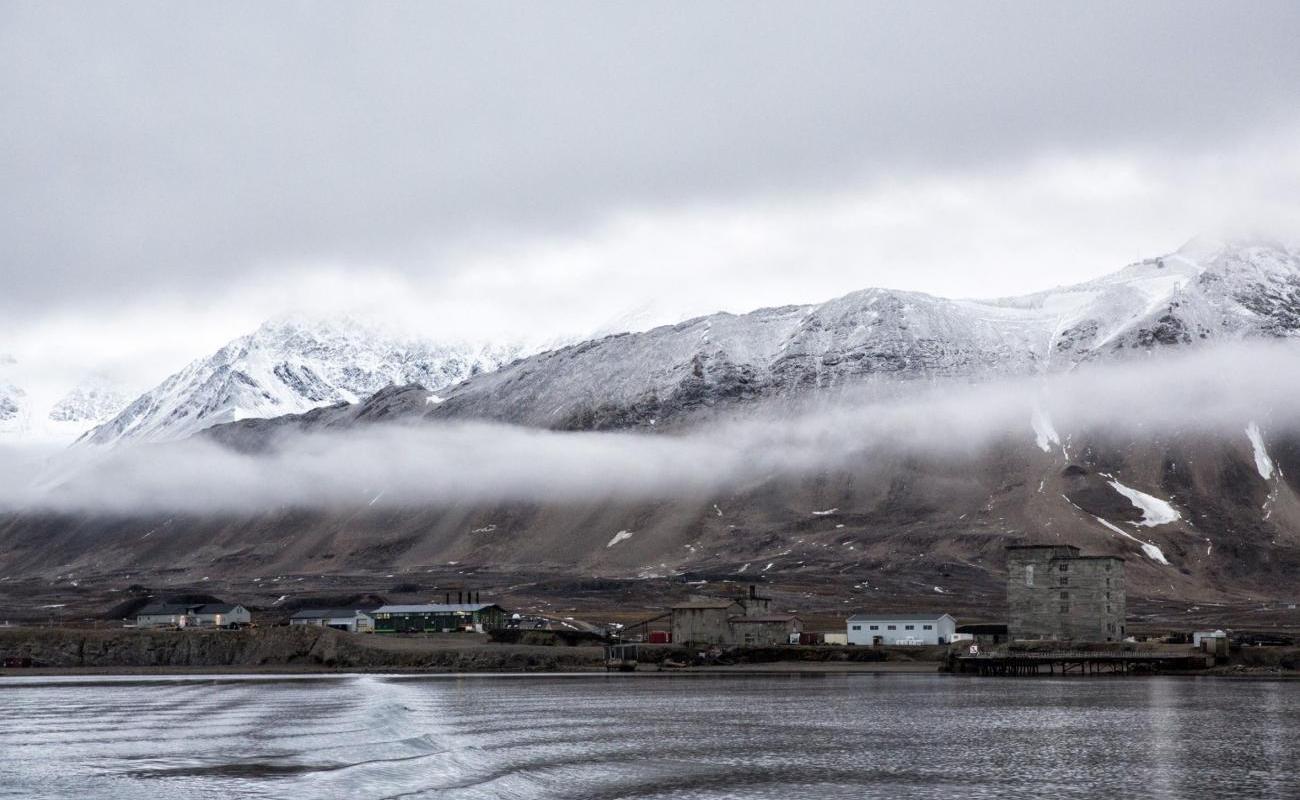
China’s growing self-confidence is also evident in an area that may seem unspectacular at first glance, but which plays an important role with regard to establishing a presence in the Arctic: science and research. In July 2004, China opened its first Arctic research station on the Svalbard archipelago in Ny-Ålesund, where various other countries also have teams. Topics being researched at the station include ecology, weather and climate observation, glaciology, and atmospheric physics.
Svalbard is an international territory under Norwegian sovereignty and administration. Under the Svalbard Treaty, which came into force in 1925, citizens of signatory states to the treaty – including China – are free to settle and work in Svalbard under certain circumstances. The treaty’s name refers to an older name for the archipelago, whose largest island is still called Spitsbergen.
Despite these legal rights, there has recently been considerable friction with the territory's Norwegian administrators. In the spring, a dispute arose over two lion statues that mark the entrance to China's Yellow River Station. The Norwegian state-owned company that manages the properties associated with the Ny-Ålesund international research complex wants the figures removed because they contravene the widely accepted practice of refraining from the use of political symbols within the complex. This rule applies to all countries that operate research stations there, the administrators said.
However, a deeper conflict lies behind this spat. Norway's guidelines for activities in Ny-Ålesun stipulate that research should be limited to the natural sciences. China and others have criticized this as exceeding the powers granted to Norway under the Spitsbergen Treaty. They want to work more broadly – for example, on issues of constitutional law and thus potentially on the interpretation of the treaty and Norway’s role in the territory.
How the treaty is to be read and interpreted 100 years after it was drawn up is a politically sensitive issue today. Major geopolitical actors have shown sharply increasing interest in expanding their influence in the Arctic region over the past two decades. And there is no binding international regulatory framework that covers the entire North Pole region.
Declining US research interest could help China
However, it is not only China's research presence on Svalbard that has an explicit political dimension, but Arctic climate research in general. Due to the breakdown in scientific exchange between Russia and the West as a result of the war in Ukraine, the international research community already faces a lack of data on around half the Arctic region.
Under President Donald Trump’s administration in the United States, American Arctic research is also being downsized. This is further impairing global data exchange.
According to scientists in the international research community, China has indicated that it is more than willing to fill this gap. Observers say Beijing regards science as an important tool to establish itself legitimately in the North Pole region, gain influence and earn prestige as a responsible global citizen.
Thus, while Trump is loudly proclaiming his intention to «take over» Greenland in order to counter China's «Arctic expansion,» he is in fact opening the door wide for Beijing with the other hand.