
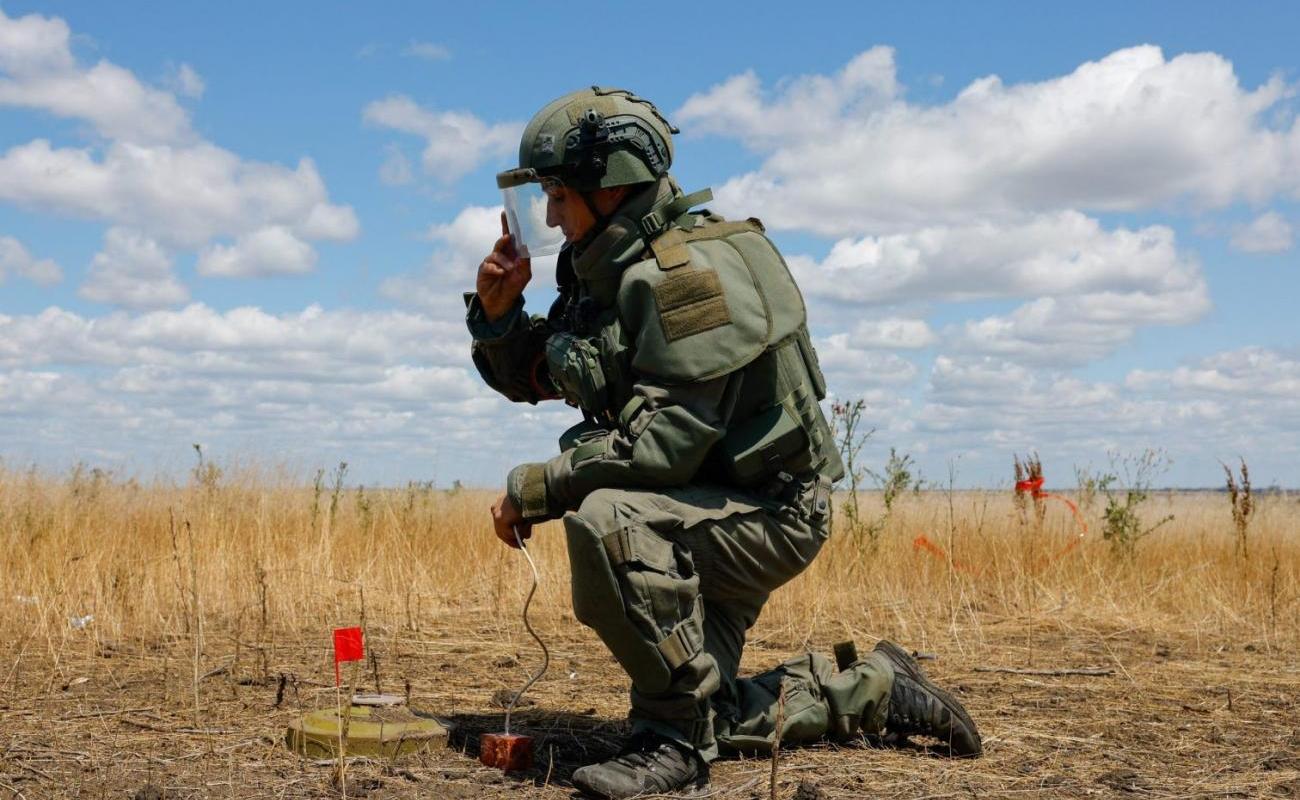

The technology of war is evolving faster than the systems it is designed to counter. Artificial intelligence, drones, sensors, and other technologies are transforming how weapons are developed, deployed, and concealed.
The clean-up technology for mines and other explosive ordnance is not immune to these changes. Much of what organizations have learned over the decades has been made obsolete by new technologies. In Ukraine and elsewhere, a new approach is needed.
The scale of contamination is now just part of the challenge: the variety, sophistication, and concealability of explosive threats make them increasingly difficult to detect, classify, and safely neutralize.
The success or failure of Ukraine’s mine clearance will directly affect how quickly contaminated land can be returned to productive use and how successfully the country can recover, and will offer lessons for the rest of the world.
The mine problem is often framed in terms of scale: How much land is contaminated? How many munitions remain? And how much time and money will clearance require? As critical as these questions are, there is a more fundamental problem: the evolving nature of the threat.
The proliferation of increasingly sophisticated, smaller, better-hidden, and often remotely multi-sensor-initiated trigger devices is challenging assumptions that have underpinned ordnance detection and disposal for decades.
New munitions, such as the POM-3, an electronically fused anti-personnel fragmentation mine which has a seismic probe to detect motion, illustrate the evolving challenges. The combination of Cold War-era munitions, such as the TM-62M anti-vehicle mine, with new electronic programmable fuses, shows how quickly munitions are evolving.
As a result, deploying more personnel, machines, and conventional detection methods will not necessarily produce better results and, in some cases, could have dangerous, life-threatening consequences.
Many of the most dangerous combinations of munitions and initiation devices, including those with programmable fuses inserted into munitions that used to rely on less sophisticated components, have not yet been encountered by humanitarian agencies because they are mostly confined to contested areas of current conflict.
But the high casualty rates among army explosive ordnance disposal teams in combat zones reflect the new and evolving challenges.
While post-conflict clearance may not be as urgent as for the military, police, and governmental organizations in wartime, adopting appropriate safety protocols will cause significant delays and increase costs.
Traditionally, an explosive ordnance disposal operator or deminer would search an area, locate a device, identify it, and then destroy it (or in some cases make it safe before moving it). And booby traps and anti-handling devices were mostly limited to when the object was lifted or pulled up.
Now there are options for the device to be set off immediately, or after a programmable delay, in response to proximity, magnetic flux, disturbance, or combinations of any of those triggers. Moving a device remotely (a traditional precaution) no longer reliably indicates that the device is safe.
Confirming the true status of the device, including any triggering mechanism, may require partial disassembly or other intrusive methods, which can themselves result in detonation.
Ukraine is now a testing ground for technologies that could help address these challenges.
Machine vision, drones, open-source intelligence, geospatial data, and other technologies offer the possibility of detecting and characterizing threats before personnel are placed in harm’s way.
The breakthrough is not necessarily that a machine can physically remove an explosive device faster than a human, but rather that more accurate data can allow authorities to determine where a threat is, what type of threat, and which areas should receive priority for further investigation or clearance.
Techniques such as stand-off destruction may become unavoidable in many areas, bringing with them implications for delays and damage to surrounding infrastructure and buildings, and compounding the challenges of reconstruction.
Policymakers, donors, and operating agencies should not try to extrapolate directly from past experience, timelines, operational progress rates, or the costs associated with previous post-conflict programs.
Some aspects will carry across, in terms of understanding the impact of ordnance contamination on societies and economies, and aspects of task prioritization. But many will not, especially in terms of the skills and knowledge required, the equipment needed, the procedures to be applied, and the rate at which operators need to adapt and innovate as new information becomes available.
Ukraine has shown it has the ability to innovate at speed during conflict, and it will need to bring a similar approach to post-conflict clear-up.
The old mine-action system, designed to identify known categories of objects and apply established responses, no longer works when adversaries can modify the physical characteristics, placement, initiation mechanisms, or concealment of those objects.
Many of the approaches, procedures, and technologies that have been used in the past have become either unsuitable or excessively inefficient and dangerous.
The underpinnings of ordnance disposal equipment, procedures, and training need to be rewritten. The scale and implications are not yet well understood, and estimates of the cost and effort needed to deal with these new threats are unreliable and unrealistic.
But the complexity of the issue has fundamentally changed the space, and technology must adapt to help rebuild a nation that has seen too much pain and suffering.