
"I didn't want to serve in the Russian army." How Russia is forcibly mobilizing Ukrainians who grew up in occupied territories (PART I)
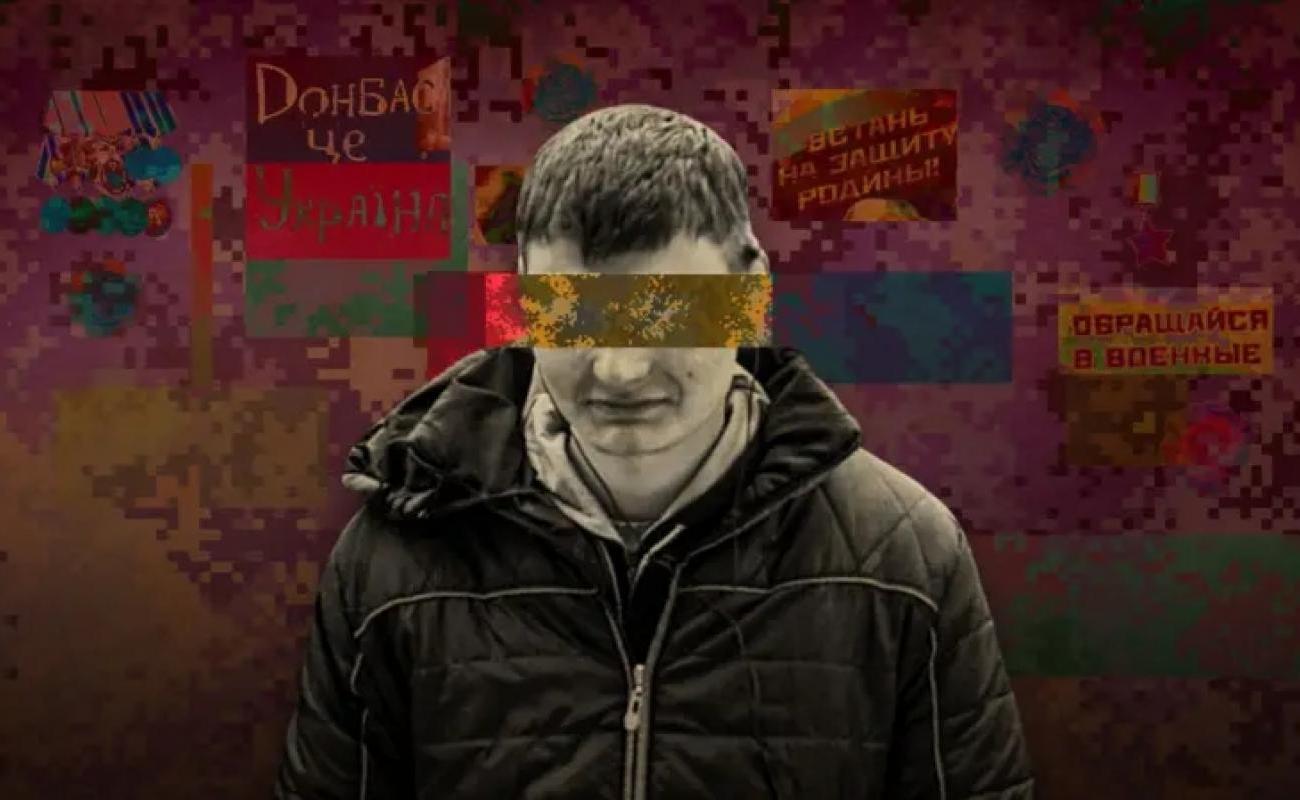
During the war in Donbas and the great Russian invasion of Ukraine, entire generations grew up under occupation. These are young men born in 1998-2005, who were still children at the beginning of the Russian occupation of their cities and towns. The decision to remain under the illegal control of Russia was largely made for them by their parents.
At the same time, this generation was maturing when the Russian Federation began to forcibly mobilize local men, citizens of Ukraine, into the Russian army in various ways. What choice do Ukrainians make when they receive a call or an offer to sign a contract with the Russian army? And did they even have a choice?
After almost 12 years of war, the occupation of some regions of Ukraine is becoming long-term. Twenty-year-old boys who remain there hear that "Russia is forever." Even seventeen-year-old boys, even before they reach adulthood, receive invitations for a medical examination and psychological tests that precede recruitment into the Russian army.
From February 2022 to January 2026, Russia forcibly mobilized 54,393 citizens of Ukraine. These data were published by the Ukrainian Coordination Headquarters for Prisoners of War. The data refer to the annexed Crimea, occupied parts of Donetsk, Lugansk, Zaporizhzhya and Kherson regions.
The BBC tells how the destinies of young men, citizens of Ukraine, who remember it well, but who grew up and/or matured under Russian occupation, unfolded.
Militarization of children
All this is happening in parallel with the militarization of Ukrainian children under occupation. The Russian military-patriotic organization "Yunarmiya" and paramilitary centers are recruiting tens of thousands of Ukrainian children in the occupied territories. They are raising them to be soldiers of the Russian army. In five to seven years, these children will become adults.
The generation born in 1998-2007 witnessed the first attempts at this mass ideologization and militarization of children in the occupied territories. The exception is Crimea, where Russia began this practice much earlier.
On the other hand, those who are even younger and have not yet reached adulthood still have their memories of Ukraine. They remember, for example, the Ukrainian flags on buildings in the center of their cities.
But those born when the war and occupation began, or later, will no longer have this memory.
The BBC gives its own estimate of the number of the youngest Ukrainian conscripts who died in the Russian army in the period 2022-2025.
This figure includes those for which information has been found in open sources and is constantly being updated and supplemented. It is part of the BBC's overall estimate of combat casualties of the Russian military during the war against Ukraine.
Avoiding conscription in Crimea
When the Russian Federation annexed the Crimean Peninsula in 2014, Artur was only seven years old (name changed. - Prim. ed.). The boy barely remembers that period.
"They removed Ukrainian license plates from cars, the war in Donbass started, they changed the symbols, then the so-called referendum. But it's all very murky."
In 2025, shortly after Artur turned 18, he tricked his parents into going to Rostov, but actually went to Ukraine.
He told his family about his real whereabouts when he was already in Kiev.
"My parents were worried about my safety. But when they found out that the Crimeans are not being tortured here by the authorities (as Russian propaganda claims. - Ed.), they calmed down."
According to him, until 2020, he, like his parents, was completely "apolitical". But in his teenage years, he became interested in journalism and started listening to foreign media in Russian. Their version of history differed significantly from the one taught in the Crimean school. This forced Artur to think critically about the beginning of the Russian war against Ukraine. He thought about leaving the peninsula.
According to Russian laws introduced by Russia in Crimea, a young man who was called up for military service had to undergo a medical examination at the military registry and conscription.
"I registered for the first time at the age of 16. Despite a serious illness - kidney hydronephrosis, I was declared fit. But they promised to release me from service during the next examination at the age of 18," recalls Artur.
However, when he reached the age of majority, the medical board repeated the same and the boy received a certificate of "fitness".
"They asked me why I hadn't had surgery, and when I said there weren't any doctors in Crimea, they were surprised that I hadn't gone to Moscow. And then they said - since I got to them on a motorbike, I'm fit."
On September 24, Artur immediately received a summons and a referral for tests, and was told to come next time on October 1 or 10.
"I realized that next time I would be issued a military summons with a curfew. And I started writing to all possible volunteer groups," the young man recalls. "When I arrived in Minsk, a family friend called me and said that he had agreed to my service in Anapa. I agreed to everything, and a few days later I was already in Ukraine."
Artur's parents saw no threat in serving in the Russian army. The guy himself had a different opinion.
"There are active military bases and legitimate military targets in the occupied Crimea. It turned out that serving there is serving against Ukraine."
"It often happens that young men who are doing military service in Crimea are simply asked to sign something, and then it turns out that they are receiving money on a card - and they are already on a contract," the guy tells the stories of his acquaintances.
After crossing the border, Artur tore up his Russian passport. But there were problems with obtaining a Ukrainian one.
"I was lucky that my mother agreed to confirm my Ukrainian citizenship online. She still had a Ukrainian passport in Crimea, although it had expired," the young man explains. Without it, it is impossible to obtain an identification code and any legal status after leaving the occupied territories.
Artur is currently preparing to enter university to study journalism. And now, together with other young men who left the occupied territories, he lives in the country house of the Save Ukraine organization.
The night before meeting the young man, the Russian Federation was actively shelling Kiev and its surroundings. Artur claims that he is not afraid of Russian shelling of the Ukrainian capital.
“When I lived in Crimea, at night I heard Russian missiles being launched, and here I hear them falling. Ukraine is also shelling Sevastopol, but - unlike Russia - only military facilities.”
According to the Coordination Headquarters, by the summer of 2025, the Russians had mobilized the largest number of men in the annexed Crimea: for the entire period of the large-scale war - 33,412 people, including 5,879 - in Sevastopol.
For comparison: 7,534 Ukrainians were mobilized in the Donetsk region, 6,146 in Luhansk, 645 in Zaporizhia, and 777 in Kherson.
Evading conscription in the occupied south
These statistics show that young Ukrainian men from the occupied territories of Kherson and Zaporozhye are already serving in the Russian army.
In the fall of 2024, Russia, according to the State Military Administration, began forced conscription for military service in these territories as well. This is confirmed by BBC interlocutors who fled the southern occupied territories due to the threat of forced mobilization. One of these young men said that the Russian Federation had taken several of his peers from a neighboring village into the army. They died.
Arsen (name changed. - Ed.), too, has heard of such cases. He is 18 years old. In May 2025, he left the occupied territories - the day after his birthday.
"I did not want to serve in the Russian army. And even more so - I did not want to fight against my country," the young man explains the main reason for his decision.
Immediately after the Russian occupation of the village, Arsen managed to avoid contact with the local administration. But later, armed soldiers and FSB officers visited his home.
The Russians discovered that the young man had been describing life under occupation in one of his Telegram channels. His phone was confiscated, and Arsen was "advised" to get a Russian passport and enroll in college.
In addition to his studies, he had to undergo a medical examination and a psychological test.
"There were more than 300 questions. They asked if I would betray Russia if I found myself at the front. This was how they checked my "psychological readiness".
After that, Arsen was issued a military ID card. The document stated that immediately after reaching adulthood, he should report to the military registry and be drafted.
Formally, it was a draft. At the same time, according to the young man, recruitment points for signing contracts with the Russian army were actively operating in the region, where they invited young people to join the army.
Even young men with serious health problems had difficulty getting a deferment from going to the army.
"I know a guy who has had heart problems since childhood. "His military record has category "A" - fully capable," says Arsen.
The appeal process against the decision involved repeated visits to the military registry, where he was forced to turn off his phones and the mobile network could suddenly disappear. The process itself, according to the young man, was accompanied by psychological pressure.
For Arsen, the training became a way to postpone conscription: "If they throw you out of college, they immediately take you into service."
"I realized that after 18 years I would have a few days to register for military service. If I don't come, there will be problems. If I come, I may not come back," Arsen explains his decision to flee.
Immediately after his birthday, he went to Ukraine. The "Bring Back the Children" initiative helped him organize the trip.
The most dangerous stage was the filtration in Mariupol.
"You can't say you're going to Ukraine. It's better to go to Poland or another EU country. They check phones, read correspondence."
Arsen crossed the Ukrainian-Belarusian border with a Ukrainian ID card.
"The woman next to me cried when she saw the Ukrainian flag. I could barely hold back," he recalls of this moment.
But among those who were children in Ukraine and grew up during the occupation, there are also those whose fate was completely different.
Some joined the Russian army voluntarily, while others were forced. Below we will tell you how this can happen.
"I said goodbye to everyone"
About a hundred men are lined up on the training ground of a Ukrainian prisoner of war camp. All are Ukrainian citizens who were drafted into the Russian army during the occupation.
16 percent of Russian prisoners of war in Ukraine as of the summer of 2025 had Ukrainian citizenship. Some have three passports at once: Ukrainian, the so-called "DNR/LNR" and the passport of the Russian Federation. Some do not have a Russian passport. And only a few do not have a Ukrainian one, because they did not submit it while living in the occupied territories.
Most of them were sentenced by Ukrainian courts under articles of the law for treason or collaborationist activities. The first refers to crimes against sovereignty, national security, territorial integrity. The second refers to service either in an army hostile to Ukraine, or in illegal armed formations of the "DNR/LNR".
The courts in each case decide which of these two articles is more appropriate to the circumstances of mobilization and service, and more precisely corresponds to the harm caused to Ukraine.
The trials of some are still ongoing. Some of these prisoners are being acquitted. This happens when the court recognizes that they were forcibly mobilized into the Russian army and did not seek economic benefits from this service. In addition, at the first opportunity, these men surrendered to Ukrainian forces. The Ukrainian authorities are currently urging them to surrender as soon as possible.
One of the youngest among them is Andriy (name changed. – Ed.). The young man agreed to tell his story.
He was captured in Ukraine at the age of 26. He was 16 when his native Luhansk was captured by pro-Russian forces in the spring of 2014. Two years later, he went to live in occupied Luhansk. He enrolled in a local college. And later he went to serve under contract in the "people's militia" of the LPR. He remained there almost until the beginning of the war.
According to him, in the second brigade of the "people's militia" he was a junior sergeant and from time to time worked as an instructor for reservists. The reservists were supposed to ensure the rapid combat replenishment of this "militia" in the event of a full-scale war.
The "people's militia" in the occupied Donbass is an army, not a law enforcement agency. They were armed with armored vehicles and large-caliber artillery.
He was attracted by a stable salary, which in 2017 amounted to 15,000 rubles (4,500 hryvnias). He says that although there was not enough money, it was possible to live on it.
But in April 2024, under pressure, he entered the 123rd separate motorized rifle brigade of the Russian army. He says that he "had a raid for drugs," for which he was threatened with criminal charges. Between that and a "one-way ticket to the Russian army," Andriy chose the latter. And signed a military contract.
"I thought: if I'm lucky, then good. And if not, then such is fate. Sooner or later we will all die."
Three days passed between the signing of the contract and the first combat mission on the front line, where he was captured.
Wasn't it embarrassing for him that he had to advance almost immediately towards the positions of the Armed Forces of Ukraine - without preparation, without coordination? He replies that he already knew everything after serving in the "people's militia" and that he did not need any training.
"On April 24, we left Luhansk. On April 25, we were at the assembly point, where we spent the night. On April 26, we set off on a combat mission. On April 27, at 07:20 in the morning, we were captured in Ukraine."
The BBC cannot independently verify the information about the length of service and the circumstances of the interlocutor's captivity.
He says the following about his views.
"I am such that I do not need either Kherson or Zaporizhia. I only need my Luhansk. I have patriotic views towards Luhansk and towards Russia."
"However, I had no motivation to fight. I worked as a bartender. That was enough for me. But I crossed the line of the law," he says.
And he adds that before going to war, he said goodbye to all his relatives, just like last time.
"I saw videos from the front, heard people's stories. I knew how the private mercenary army Wagner "chased" prisoners. So I knew very well that this was a one-way ticket. When I was leaving, I said goodbye to everyone. I did not go to the war that was in 2022. It was already a war of drones. Surviving under them as a staff member was a one in a million chance. I was afraid of that, but there was no panic," says Andrij.
His mother supported her son's decision to sign a contract with the Russian army. "Because my mother is for Russia," he emphasizes.
And she recalls that as early as 2014 she had pro-Russian views, even though she lived in the territory controlled by Ukraine until 2022. Their village was occupied by Russia during the full-scale invasion. According to Andriy, when he turned 16, his mother decided not to take his son's Ukrainian passport. Later, he did not do this either.
Upon returning to Ukraine, he decided: either he would serve in the army or become a football player.
"We had Cossacks, in Ukraine there was a military-patriotic game 'Zarnitsia'. That was in 2011. My labor teacher was a Cossack ataman".
Even before the war in Donbass, these organizations, promoting the traditions of the Don Cossacks, expressed pro-Russian views and were actively supported by Russia.
And in 2014, local Cossack societies were formed in the Luhansk region, which were already openly opposed to Ukraine, illegally seizing local power and fighting for influence with the "LPR".
But the Soviet-Russian military-patriotic game "Zarnitsia" in Ukraine was promoted by former Minister of Education Dmitry Tabachnik. In 2024, Ukraine sentenced him in absentia to 15 years in prison for high treason, aiding an aggressor state, and war crimes. In January 2025, an appeals court upheld this sentence.
In Russia, this game was later made nationwide. Now the Russians are pushing its new version, "Zarnicia 2.0", and it is active in schools in the occupied territories. During this game, children play war and learn to "be patriots of Russia". Young soldiers of the Army actively participate in "Zarnicia 2.0".
At the same time, he says that until 2018 he studied Ukrainian at a university in Luhansk. He still understands it well and from time to time involuntarily inserts Ukrainian words.
Andriy admits that in Luhansk, which has been occupied since 2014, there are still people who are pro-Ukrainian.
By the way, none of his classmates served military service in Russia. And one of his friends fled from Luhansk abroad to avoid mobilization.
Towards the end of the conversation, Andriy admits that he did not change his views in captivity and that he wants to return to Luhansk. He hopes to be exchanged.
In the same POW camp where he is currently being held, the BBC managed to speak to another captured Ukrainian citizen. He is the same age as Andriy, has a Ukrainian passport and does not support Russian actions. He surrendered to Ukrainian captivity at the first opportunity.
This prisoner was not ready to tell his personal story, but he shared some memories. For example, among his acquaintances of the same age, he recalled a case when a guy he knew fled from the occupied territories in order to avoid being forcibly mobilized.
He also said that in 2022 it was almost impossible to meet men of mobilization age on the streets of his city. They hid or ran away.
And those who could not, ended up in the Russian army. Young men were recruited on the streets, in markets, in shops, in minibuses.
However, there were also those who volunteered for service and died.