
"I didn't want to serve in the Russian army." How Russia is forcibly mobilizing Ukrainians who grew up in occupied territories (PART II)
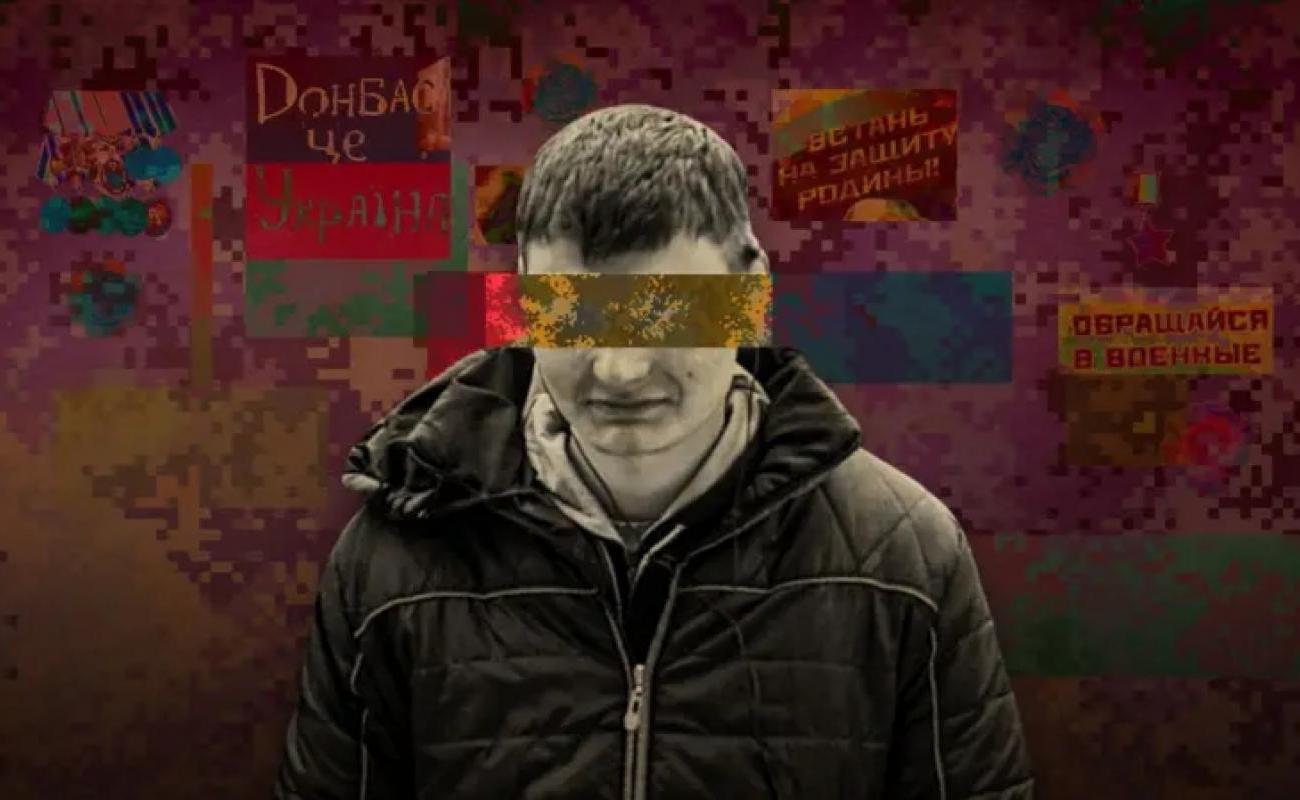
From mobilization to death sometimes – one day
Another “heroic table” was opened in school number 1 in the city of Kalmykske, Donetsk region. The occupation authorities call it in the Soviet style – “Komsomolsk”.
This table was dedicated to 20-year-old Ivan Shifman, a graduate who was a member of the “Yunarmiya”. At the age of 20, he went to the Russian war against Ukraine on the side of Russia and died.
The “heroic table” is an all-Russian tradition of dedicating tables to graduates who died in the war. Their example should inspire other children to be ready to “defend the homeland”. And, in fact, this creates a cult of war and forms the attitude that dying for Russia is an “honor”.
About a month and a half have passed since Ivan’s recruitment and his death near the village of Novobakhmutovka on April 14, 2022.
His enlarged photo in a beret and a beige suit of a young soldier is pasted on the board of the “heroic table”. Only excellent students and school activists will sit behind it, because "it is a special honor." During classes, they will spread out textbooks and notebooks precisely on this photo.
His biography, printed next to it, will remind them of "heroism and love for the homeland." And it contains the dates of birth and death: 09/22/2001 - 04/14/2022.
"After coming of age, Ivan joined the ranks of the "people's militia"
"Donetsk People's Republic" and began serving in the first Slavic brigade. When the "special operation" began in Donbass, Vanya stood up for the defense of the "fatherland." From the first days, Ivan was in the most dangerous places on the front line," says the announcement about the opening of his "heroic table."
After graduating from school, Ivan managed to enter college and also study at the "Donetsk Technical University," as stated in his biography. However, in reality, this University has moved to the territory under the control of Ukraine. The so-called "DNR" occupied his buildings and opened their educational institution there.
In total, he spent only about a year in "Junarmia". Many of those who will complete the full multi-year militarization course between the ages of eight and 11 to 18 are still children. After all, this organization started its activities in "DNR" in 2019.
The BBC studied data on the deaths of hundreds of people like Ivan Šifman. These are very young Russian soldiers from the "DNR/LNR", their years of birth are 2000-2005. It is worth paying attention to several characteristics of this age category of Ukrainian citizens mobilized in the occupation.
First, in 2022, we recorded a fairly large number of cases where only one day to two months passed between the date of their entry into service and their death. However, such cases were not isolated in 2023 and 2024.
Secondly, among these deceased citizens of Ukraine are students of universities from the occupied Donbass, in particular from the Luhansk Dahl University, that is, that part of it that remained in the occupied territory. The rest of the staff and students left the occupation and continued to work in the territory controlled by Ukraine.
In 2022, the occupation authorities mobilized students into the "people's militia of the LNR". The BBC found information about at least five deceased students from various faculties and institutes of this University.
It is worth noting that there are no reports of the death of students on the official pages of this University on social networks. Since the beginning of the large-scale war, only stories about their bright future and good prospects for those studying there have been published there.
A source who was then in the territory of the so-called "LNR" also told the BBC about the death at the front of a large number of students mobilized into the "people's militia" "DNR/LNR".
Thirdly, the absolute majority of Ukrainian citizens ended up in the ranks of those units that Russia formed on the basis of the so-called "people's militias" "DNR/LNR". These are, for example, the 114th and 123rd motorized rifle brigades of the Russian ground forces, the "Somali" battalion and the "Kerch" assault detachment.
According to Ukrainian military intelligence, the newly formed units are mainly subordinate to the Southern Military District of the Russian Federation.
BBC News Ukraine and a joint project of the BBC, "Mediazones" and volunteers conduct their own calculation of the number of deaths in the ranks of the Russian army born in the period 2000-2005. year. As of the beginning of February 2026, we have identified at least 241 soldiers of this age from the occupied territories of Donetsk and Luhansk regions. They died in the period from February 2022 to December 2025.
Information about them was obtained from obituaries in local media, posts by their relatives, friends and school administrations where they studied, on social networks. As well as from materials on local websites and messages from the Telegram channel of "Yunarmiya".
The BBC estimated that the average duration of their service in the war until death was about 170 days, that is, a little less than half a year. It is worth noting that it was not possible to find the exact dates of mobilization or conscription and death in all cases. Therefore, this figure is not final, but reflects the trend and the general picture throughout all the years of Russian aggression.
In the ranks of the Russian army alone, in 2022 alone, about 20,000 soldiers from the territory of the "DNR/LNR" died. This is an estimate given by BBC journalist Olga Ivshina. She coordinates a project to track the total number of deaths in the Russian army during the large-scale invasion.
There is currently no such data on how many of these 20,000 mobilized, conscripted or contract soldiers are between the ages of 18 and 22.
The Ukrainian Coordination Headquarters for Prisoners of War, as follows from the data it has published, considers the forced mobilization of Ukrainian citizens to be both the above-described forced recruitment into the Russian army, and seasonal or continuous recruitment for military service, and signing a contract. To this should be added general or partial mobilization as such.
These are all different ways of entering military service. But the essence is the same - forcing to participate in hostilities on the side of the Russian Federation against one's own country.
General mobilization in the occupied territories of eastern Ukraine was declared on February 19, 2022. It also affected students. Several waves took place there. This mobilization was carried out by local military registration and enlistment offices formed after 2014.
Between 2015 and February 2022, no conscription was carried out in the "DNR/LNR". Only contract soldiers served in their "people's militias". According to the GUR, only a third of them were local residents. About 70 percent were Russian "volunteers" and officers.
At the same time, since September 2022, a partial mobilization has been underway in Russia itself, which has not been canceled.
In September 2022, Russia held a pseudo-referendum in the occupied territories of Ukraine at gunpoint to declare their illegal annexation. After that, it introduced its own conscription system and military registration and enlistment offices there, which maintain military records of the local population.
Since then, local young men have been called up for medical examinations and psychological tests. Some received these calls at the age of 17.
On October 28, 2025, the State Duma of the Russian Federation adopted a resolution on unlimited conscription into the ranks of the Russian Federation, that is, the conscription campaign there has become continuous. After compulsory service, Russians are encouraged to sign contracts. Otherwise, a person with military experience will still be mobilized.
From the biographies of deceased Ukrainian citizens born in 2000-2005. It is noticeable: in the period 2023-2025, the number of contract soldiers among them increased. At least some of those who were forcibly mobilized in 2022 were recorded as "volunteers".
What's next
Young men, citizens of Ukraine, will one way or another continue to be faced with a choice - what to do when the Russian call comes or when they are forced to sign a contract with the Russian army.
First, among them are those who do not want to live in Ukraine and do not associate with it, like Andriy. After being captured, they want to return to Russia or to the occupied territories. They have anti-Ukrainian views.
The Ukrainian state should decide whether it can even exchange prisoners of Ukrainian citizens from the occupied territories at the request of Russia.
The official position on this was expressed in November 2025 by the Secretary of the Coordination Staff, Brigadier General Dmytro Usov.
According to him, this issue can be considered in parliament. The Verkhovna Rada could make amendments to the law.
“We must make the right decision when there is a request from the Russian side for their exchange, because the exchange of Ukrainians for Ukrainians is taking place. We must do everything to ensure that they do not return to the Russian Federation, but remain in Ukraine,” Dmitry Usov emphasized, speaking at the Crimea Global conference in November 2025.
At the same time, the “I Want to Go to My Own” program is in operation for Ukrainian citizens accused of collaboration in Ukraine. Those who volunteer to participate in it turn to the Russian side with a request for their exchange.
Secondly, Ukrainian citizens who find themselves in the Russian army are either victims of the war crime of forced mobilization during the occupation, or are suspected of treason or collaboration. The first happens if the person was under pressure and threats. The second is when it was a voluntary decision.
Article 8 of the Rome Statute of the International Criminal Court recognizes as a war crime the coercion of a person to serve in a foreign army that is at war with their own country.
The Fourth Geneva Convention prohibits the recruitment of civilians into service in an occupying army.
Ukrainian courts have already issued acquittals in some cases. They do so when they receive evidence of forced mobilization, conscription, or signing of contracts against Ukrainian citizens under occupation.
“And we are waiting for them to be released from the camps,” emphasized Dmytro Usov.
If Ukraine in absolutely all cases, regardless of coercion, punished those who joined the army of the aggressor state, this would discourage its citizens from thinking about voluntary surrender. If such a person is considered a traitor in any case, the incentive to fight disappears.
At the same time, Ukraine should hold its citizens accountable for such serious crimes as high treason or collaborationism, if there is evidence of guilt.
“At the beginning of this process, I simultaneously believed that they should be perceived as victims. Now I look at it a little differently. It is unlikely that there will be forced mobilization if a person serves for a long time, receives money and signs a contract,” notes Andriy Yakovlev, lawyer, general director of Umbrella JSC and expert at the Media Initiative for Human Rights (MIHR).
The Prosecutor General's Office of Ukraine responded to the BBC that psychological or physical pressure on citizens of occupied Ukraine "excludes their criminal responsibility for participation in an armed conflict on the side of the aggressor country." Under Ukrainian law, such coercion is a war crime.
The participation of Ukrainian citizens in the war on the side of the Russian Federation as part of its private military companies is clearly considered high treason.
In other cases, law enforcement agencies and the court consider evidence of possible coercion and assume that the person is a victim.
The question arises as to how the state and society could support young people under occupation: from psychological assistance programs to assistance in finding a job and securing housing.
So far, Ukraine has no coherent policy on this. And access to information about leaving for territory controlled by Ukraine is limited.
Despite this, some of the young people who grew up under occupation, like Arsen and Artur, are choosing Ukraine, a European future, and life itself.
"Even my Russian passport (issued in Crimea. - ed.) said that my place of birth was Ukraine. I didn't want to be its traitor," says Artur about his choice. All the names of the BBC's interlocutors who spoke about their experience of serving in the Russian army or avoiding conscription during the occupation have been changed at their request or for security reasons.