
Russia’s Pervasive Influence in the Western Balkans
Western and local officials and experts have often depicted Russia as deliberately destabilising the Balkans to hinder EU and NATO integration. Both the EU Commission president, Ursula von der Leyen, and the foreign policy chief, Kaja Kallas, spoke out against “Russia’s ‘hybrid war’ aiming to destabilise Western Balkan democracies”. Yet, Moscow’s official documents and resource allocation suggest that the region is not among Russia’s top foreign policy priorities. Russia’s 2023 foreign policy concept makes no mention of the region, further suggesting that the war against Ukraine is currently absorbing nearly all of Moscow’s political, economic, and military attention.
Even so, Moscow retains some influential political and energy levers in the region – and strong historical, cultural, and religious ties to Serbia, its traditional foothold in the Balkans.
Russia’s presence in the Balkans
Russia’s influence in the Balkans is often portrayed as a direct, top-down process or as orchestrated, malign economic penetration. However, as Vuk Vuksanovic maintains, it is less a product of centralised Kremlin strategy than of alignment with sympathetic local leaders. Moscow benefits from, rather than directly orchestrates, many of the region’s tensions. Authoritarian-leaning governments such as those in Serbia and Bosnia and Herzegovina’s Republika Srpska (RS) have taken inspiration from the Kremlin’s model of top-down governance, echoing its approach to dissent, media control, and institutional capture.
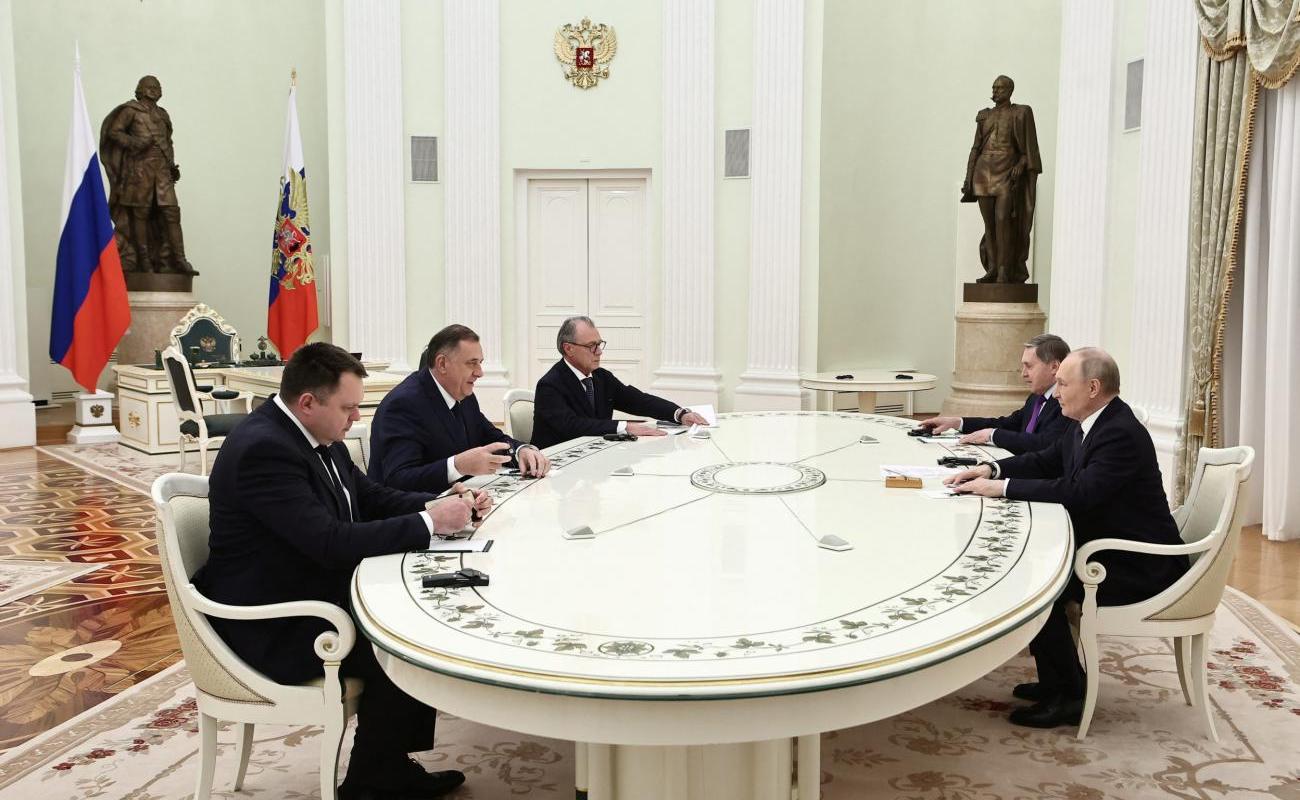
Moscow exploits two local phenomena in particular – first, the deterioration of democratic standards, especially visible in Serbia. President Aleksandar Vučić has ruled in increasingly authoritarian fashion since 2012, while RS leader Milorad Dodik has pursued policies that undermine Bosnia’s constitutional order. Both maintain close personal ties with Vladimir Putin. Since 2022, there have been at least nine meetings between Dodik and Putin.
Serbia and the RS are the only European entities that have not imposed sanctions on Russia since the invasion of Ukraine. Bosnia formally aligned with EU sanctions but has never implemented them.
In Serbia, democratic regression has long been evident. Media are tightly controlled, state contracts are opaque, and civil society organisations are subject to harassment and surveillance. In Republika Srpska, the government has followed the Russian playbook even more closely. In February 2025, it adopted a “foreign agents law” that will severely restrict NGOs and independent media. The legislation mirrors similar laws in Russia, Georgia, and other post-Soviet states designed to stifle external influence and suppress opposition voices. Russia has also echoed President Vucic in labelling “colored revolution” the anti-government protests that have crippled Serbia over the past year.
The second phenomenon is the existence of a strong religious sentiment, not entirely disconnected from political power. By tapping into Orthodox cultural and spiritual affinity, Moscow cultivates loyalty among majorities in Serbia, Montenegro, and North Macedonia, as well as significant groups in Bosnia. Alexander Botsan-Kharchenko, Russian Ambassador to Serbia, has accused the West of destroying Orthodox values.
Ideological affinity: the “Serbian World”
Ideological parallels between Belgrade and Moscow run deep. A key architect of these ties has been Aleksandar Vulin, Serbia’s former deputy prime minister and intelligence chief. Labelled as a “Kremlin ventriloquist”, Vulin maintained open channels with Moscow while Vučić publicly avoided meeting Putin for over three years. Sanctioned by the US in 2023, Vulin nevertheless represented Serbia at the BRICS summit in Kazan in 2024, where he again met Putin despite EU objections.
In 2021, while serving as interior minister, Vulin revived the notion of a “Serbian World” – a political and cultural space uniting all Serbs in the region, intended to counter the alleged expansion of “Greater Albania.” The project echoes both the “Greater Serbia” ideology of the 1990s and the Kremlin’s doctrine of russkiy mir (“Russian World”), which fuses cultural identity with geopolitical ambition.
Russia has also used the “Kosovo card” as the basis for its political ties with Belgrade: by preventing Kosovo’s UN recognition, Russia cultivates the image of a protector of Serbia’s borders, securing public sympathy and strengthening Belgrade’s allegiance. However, Russia’s role in the Kosovo issue is limited and indirect. Besides the political alliance between Belgrade and Moscow, for which the non-recognition of Kosovo is fundamental, Russia has no boots on the ground and does not directly fuel tensions as much as Belgrade does. The Belgrade-Moscow alliance is pragmatic and based on mutual interests, rather than on pan-Slavic brotherhood, as the propaganda claims. Russia seems to be reaping the benefits of this strategy: opinion polls consistently reveal Serbs’ pro-Russian (and anti-NATO) stances, even in the context of the war against Ukraine.
The future of the energy card
Energy has long been described as Moscow’s most tangible instrument of influence in the Balkans, though its power was often overstated. Serbia depends heavily on Russian gas, supplied through regional pipelines and managed under long-term contracts with Gazprom. After Ukraine’s invasion in 2022, Vucic signed an “extremely favourable” three-year gas supply deal with Russia, which has now been extended until the end of 2025. Bosnia and Herzegovina and North Macedonia also receive a small portion of their energy from Russian gas.
While the gas trade underpins political closeness – reinforcing perceptions of shared economic destiny and helping Serbian leaders justify ongoing ties with Russia despite Western pressure – its strategic weight should not be exaggerated. In Serbia, natural gas represents roughly 15% of total energy consumption, far below coal and oil. Bosnia and Herzegovina and North Macedonia also import limited quantities of Russian gas but rely primarily on coal. None is a major buyer on a global scale; compared with Germany, Turkey, or Italy, the Balkans are marginal to Moscow’s energy calculus.
Gazprom also owned a majority stake in Serbia’s Oil Industry (NIS), which used to run the country’s only refinery. However, NIS’s Russian ownership has become a liability, especially after 2022: since October 2025, NIS is on the US sanctions list following Russia’s invasion of Ukraine, prompting the Russian side to transfer control and influence over NIS to a third party.
Pervasive Russian links
Despite limited resources, Russia continues to exploit this alliance as part of its wider confrontation with the West. Political links between Moscow, Belgrade, and Banja Luka (RS’s capital) ensure a continuing Russian presence. After the invasion of Ukraine, thousands of Russians relocated to Serbia – some evading conscription, others seeking safety or investment opportunities. Their arrival, especially of affluent émigrés, has fuelled resentment in Belgrade amid soaring rents and property prices. Yet the Serbian government has also helped Moscow on Russian dissidents, reportedly facilitating the expulsion of opposition figures at the Kremlin’s request. Independent Russian and Serbian media later revealed that Belgrade had granted citizenship to more than 200 Russians linked to the FSB or sanctioned state enterprises such as Gazprom – officially citing “Serbian national interests.” The move effectively provided these individuals with visa-free access to the EU, strengthening Moscow’s network of influence.
While Russia cannot compete with European or Chinese trade and investments, its low-cost strategy of supporting divisive narratives, exploiting local cleavages, religious sentiment, and frustration with the slow EU enlargement process allows it to retain pervasive influence that will endure despite Moscow’s “distraction” in Ukraine.