
China’s tacit entry into Bosnia and Herzegovina
By Dino Cviko Respublica
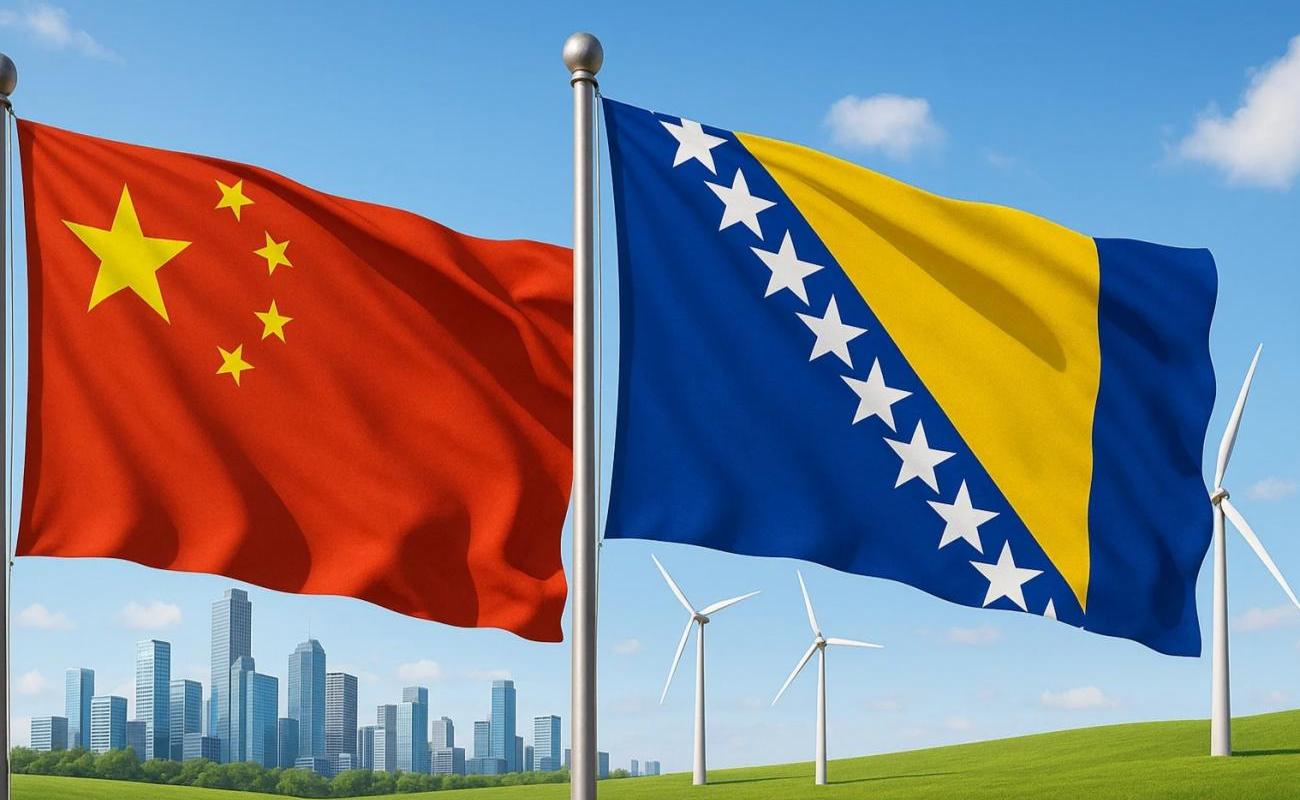
The Belt and Road Initiative is a long-term global strategy of the People’s Republic of China, through which Beijing, by providing investments and loans, seeks to connect China with the rest of the world and strengthen its economic and political influence.
This influence has been increasingly visible in Bosnia and Herzegovina in recent years. Bosnia and Herzegovina formally became part of this project in 2017, with the signing of the Memorandum of Cooperation within the framework of the “Belt and Road” Initiative in Beijing, the document was signed by the then Minister of Foreign Trade and Economic Relations Mirko Šarović on behalf of Bosnia and Herzegovina.
At the time, it was announced that China had “made available” more than 100 billion euros for various projects, although it was never clarified how much of that amount was intended for Bosnia and Herzegovina, nor how much would come as direct foreign investments and how much as loans. It turns out that that difference is very important.
Loans with no “extra” questions
It has been more than eight years since the signing of that Memorandum, and the time so far has shown that Chinese investments and, to a greater extent, Chinese loans, are not exclusively economic in nature, but rather serve towards overall positioning of this power in the region. Analyses have shown that the lack of transparency of Chinese projects in Bosnia and Herzegovina encourages the already widespread corruption in the country.
Chinese influence is pushing the Western Balkan countries, including BiH, away from the European Union. The reason for this, as reported by euractiv.hr, is that the strong Chinese influence is not in line with the acquis of the EU in a number of areas, especially rule of law, freedom of movement of goods, public procurement, commercial law and media freedom.
However, unlike Russia, China does not conduct open and loud disinformation campaigns in Bosnia and Herzegovina. CEPA’s review of the Chinese influence in Bosnia and Herzegovina shows that China has established a recognizable presence – primarily economic, but also political and cultural – especially in the BiH entity of Republic of Srpska, and China is not yet using that presence for clear political pressure.
If the campaigns are not open and visible, it does not mean that they do not exist. The narrative according to which Chinese companies and financiers, usually under the control of the Chinese Communist Party, are ready to finance projects in the country, but without the demands for “interference in internal affairs” and painful reforms that the EU insists on, makes the West less necessary and more hated among political elites and some parts of the public.
The economy is the main channel for the message: “EU means conditionality and reforms, Beijing means money with no questions asked.” This image is sold through domestic politicians and the media outlets as a rational, even “sovereign” choice for Bosnia and Herzegovina.
This narrative does not remain just at the level of reports. Milorad Dodik, former President of the BiH entity of Republic of Srpska and president of the ruling SNSD party, has repeatedly described China as a more desirable partner than the West. Back in 2021, he said that China had proven to be an “important partner” that “has no political demands or conditions,” which, he said, was “the best way” of cooperation.
A few years later he went a step further, saying that China is “becoming the most important financial and investment partner of the BiH entity of Republic of Srpska”, and that China is “the complete antithesis of the West where every kind of conversation, aid, support comes with political conditioning”. This, Dodik pointed out, “you cannot see from the Chinese side”.
Even some politicians from the Federation of Bosnia and Herzegovina entity made similar statements. Haris Zahiragić (SDA), a representative in the Assembly of the Sarajevo Canton and a delegate in the House of Peoples of the FBiH Parliament, is outraged at the international community, which, he claims, is actively working to destroy the electoral will of the Bosniak people. He said:
“If the international community continues to treat the political will of the Bosniak people in this way, I will personally make an effort and ensure that the Bosniak people start looking for new friends in the world.”
When asked which friends, Zahiragić answered: “Various, both Chinese and Russian…”
When it comes to officials of Bosnia and Herzegovina, the Minister of Foreign Affairs Elmedin Konaković, at the meeting with Chinese Ambassador Li Fan in March 2025, emphasized that improving political and other relations with China is “an important commitment for Bosnia and Herzegovina.”
Corrosive capital
The analyzes of the Chinese presence are increasingly using the “corrosive capital” phrase. This is money that enter systems that have weak rule of law and, instead of strengthening them, they further erode institutions. China is now among the world’s largest creditors of low- and middle-income countries, and some countries have, de facto, reduced themselves into debt slavery.
As for Bosnia and Herzegovina, the most visible traces of Chinese presence are infrastructure and energy projects, and their main features are disputed loans, lack of transparency and suspicion of corruption – from the Dabar Hydroelectric Power Plant, through the construction of the Doboj hospital and highways, all the way to the failed project to build Block 7 of the Tuzla Thermal Power Plant.
That China is not even politically neutral, is also demonstrated by the fact that, for example, it was one of only 19 countries that voted against the adopted Resolution on the Srebrenica genocide in the UN General Assembly, as well as the fact that, together with Russia, it pushed for a resolution in the UN Security Council that would have stripped the High Representative for Bosnia and Herzegovina of his powers. The proposal was ultimately rejected.
Such negative aspects, however, are almost non-existent in domestic political discourse in both entities. China presents itself to the public as an economic, almost benign partner, unlike Russia, which is associated with open political conflicts.
Confucius Institutes
In addition to loans and infrastructure projects, China’s presence in Bosnia and Herzegovina is also being established through educational and cultural channels. There are Confucius Institutes operating at the universities in Sarajevo and Banja Luka, which offer free Mandarin language courses, organize competitions, lectures on Chinese culture…
Analyses like CEPA’s studies regarding Chinese influence in There are Confucius Institutes operating, point out that the Confucius Institute in Banja Luka is particularly active, which normalizes China’s presence as something normal and desirable, and not necessarily as a geopolitical issue.
Through such programs, China us building long-term networks of sympathy and contacts among the academic, cultural, and political elite, with minimal public debate about what such “cultural diplomacy” means for the country’s strategic orientation.
Despite warnings from the EU and warnings from numerous analysts, Bosnia and Herzegovina continues to tacitly deepen relations with China. In September 2025, the Director of the Agency for Promotion of Foreign Investments, Marko Kubatlija, signed in Shanghai a Memorandum of Understanding with Chinese partners, which was presented as a “new chapter in the cooperation with the People’s Republic of China” and an opportunity for new investments in Bosnia and Herzegovina.
All of this suggests that the economic and cultural channels of China’s presence in BiH are tacitly reshaping the domestic political narrative about development, partnerships, and alleged “alternatives” to the EU – without much fanfare, but with possible long-term consequences.