
Serbia's 'Future' Put to the Test: State Department on Belgrade-Beijing Rapprochement Driven by AI
Summary
- In recent months, Serbia and China have moved significantly closer in the field of artificial intelligence.
- The State Department warns that the future of the Serbian economy depends on political decisions made today.
- The EU states that closer ties with Chinese technologies complicate alignment with Brussels' requirements on the path to European integration.
Serbia's future economic prospects will depend on the political decisions and choices of partners it makes today, the State Department warned in a response to Radio Free Europe (RFE) regarding Serbia's growing alignment with China in the field of artificial intelligence.
At the same time, the European Commission (EC) noted that aligning with European Union rules on artificial intelligence is part of the broader process of European integration.
"As part of the accession process, Serbia has committed to aligning its legislation with these regulations," an EC spokesperson told RFE.
The EU Institute for Security Studies told RFE that deeper integration with Chinese technology ecosystems could complicate future alignment with Brussels' requirements on the path to EU membership.
Serbia has been a candidate for EU membership since 2012.
Over the past few months, Serbia has moved significantly closer to China in the field of artificial intelligence by signing high-level agreements.
China is not the only country interested in cooperating with official Belgrade in this area. This was also one of the topics during the visit of French President Emmanuel Macron in August 2024.
What did Vučić sign with Xi Jinping?
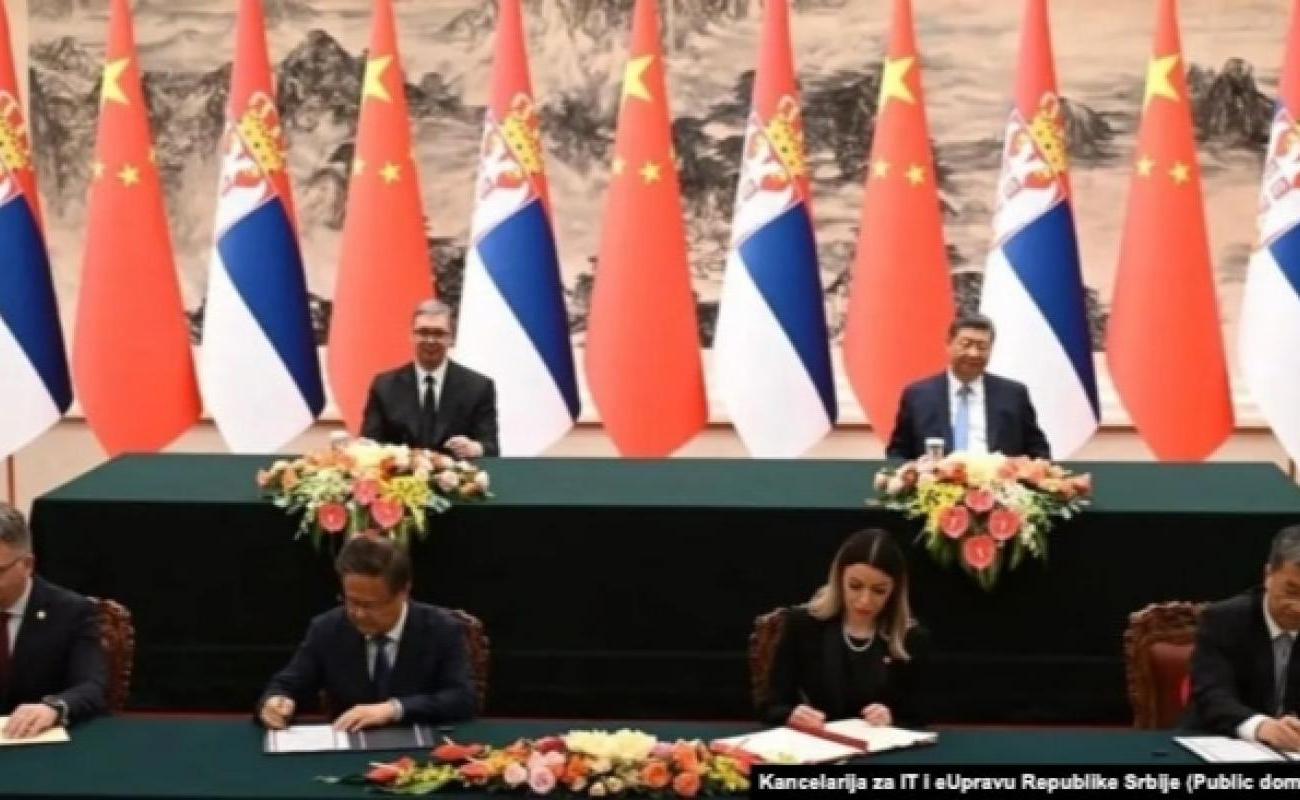
In May, a memorandum on cooperation between the two countries in the field of artificial intelligence was signed in Beijing in the presence of presidents Aleksandar Vučić and Xi Jinping.
Two months later, in July, representatives from 29 countries—including Serbia—signed an agreement in Shanghai to establish the World Artificial Intelligence Cooperation Organization (WAICO).
Among European countries, only Russia and Belarus are signatories. The signatories are predominantly Asian and African states, and Iran subsequently joined the organization.
The agreements come at a time when the state is seeking to accelerate the development of national AI capabilities.
In early 2025, the Serbian government adopted a new Artificial Intelligence Development Strategy through 2030, outlining additional investments in research, computing infrastructure, and the deployment of AI systems within the public sector.
The Republic of Serbia’s Office for IT and e-Government did not respond to an inquiry from RFE/RL regarding the signed agreements—specifically whether Chinese artificial intelligence would be used in state institutions—nor was the signed memorandum made available for review.
What is known about the agreements with China?
A memorandum of understanding on enhancing cooperation in the field of artificial intelligence was signed in Beijing in May on behalf of Serbia by Mihajlo Jovanović, Director of Serbia’s Office for IT and e-Government, while the document was formally approved on the Chinese side by the National Development and Reform Commission (NDRC).
"Cooperation between Serbia and China in the field of modern technologies—including artificial intelligence, robotics, and digital innovation—represents one of the most dynamic and promising segments of overall bilateral relations and a vital foundation for further linking the scientific-research and technological capacities of the two countries," Jovanović said at the time.
According to a statement from the Development Agency of Serbia following Vučić's visit to China, more than 30 agreements and memoranda were signed during the trip, and it was noted that Serbia is a potential regional hub "for Chinese investments in industry, logistics, and technological development."
In July, Serbia moved a step closer to China in this field with the establishment of WAICO—the World Artificial Intelligence Cooperation Organization—in Shanghai.
A month earlier, the Serbian government had adopted a decision to conclude the agreement establishing the organization, thereby officially assuming the status of one of its founding members.
The initiative for its formation was launched by China a year prior, amid warnings that artificial intelligence could become the exclusive privilege of a small number of nations and companies unless broader cooperation in high-tech sectors was established globally.
Through its membership in this organization, Serbia will, among other things, gain access to free open-source AI models, utilize Chinese AI as a cost-effective alternative to pricier solutions from Western tech companies, and have the opportunity to train its experts in China via a planned scholarship fund.
US Urges Serbia to Choose 'Trusted Sources'
The State Department declines to comment directly on the growing ties between Belgrade and Beijing in the field of artificial intelligence, but emphasizes that the choice of which side to align with is clear.
"The United States encourages Serbia to realize its full potential—and ensure its national security—by selecting trusted sources and suppliers for artificial intelligence equipment and technology, as well as by choosing trusted partners like the United States," the response emphasizes.
It also notes that the US leads in artificial intelligence technology and sets the gold standard for technology that is "responsibly developed, grounded in transparency, and free from ideological biases and government-imposed manipulations."
"When countries adopt American artificial intelligence systems, they are not merely purchasing infrastructure as consumers—they are unlocking innovative opportunities for their economies and citizens," the response states.
The US has long held the official position that the development of Chinese artificial intelligence could enable the modernization of China's military and surveillance capabilities, prompting the imposition of increasingly strict export controls.
In 2022, the US Department of Commerce introduced restrictions barring China from accessing cutting-edge AI chips, supercomputing technologies, and advanced semiconductor manufacturing equipment, citing the need to protect US national security.
What is Brussels reminding Serbia of?
In a response to RFE, the European Commission states that Serbia has committed to aligning with Brussels' regulations, including the European framework for AI governance and the EU's adopted Artificial Intelligence Act.
They explain that EU rules apply not only to companies based within the Union but also to providers of AI systems and models operating in the EU market, including companies from third countries.
The EU has long sought to position itself as a leading global regulator in the field of artificial intelligence, prioritizing the protection of human rights and strict risk control.
Through the implementation of the AI Act, which came into effect in August of this year, Brussels aims to ensure that advanced technologies are developed exclusively within the framework of democratic standards, transparency, and the protection of citizens' privacy.
A response from the EU Institute for Security Studies, signed by analysts Bojana Zorić and Clotilde Bomont, highlights that an AI partnership does not, in itself, constitute a violation of Serbia's obligations under the EU's Common Foreign and Security Policy; however, it does raise new questions regarding Belgrade's strategic orientation.
"For the EU, the primary concern is that Serbia is gradually integrating into technological and governance ecosystems that may differ from European ones. This is particularly significant given that Serbia's alignment with the common policy is already incomplete and far from satisfactory," the Institute warns.
They point to the Huawei Safe City technology already adopted in Serbia, noting that its implementation raises concerns regarding the potential for mass surveillance and data security—issues further complicated by artificial intelligence.
"Combining artificial intelligence with sensitive data, surveillance infrastructure, and reliance on external suppliers increases cybersecurity and espionage risks, while rendering vulnerabilities systemic," the Institute assesses.
Zorić and Beaumont believe there is a risk of technological dependence on China.
"Dependence arises when a single technological ecosystem gradually provides the infrastructure, hardware, cloud or computing capacity, software, AI models, and technical expertise. Once these layers become interconnected, switching becomes costly and politically difficult," they explain.
They believe the EU must offer the entire Western Balkans alternatives to AI integration with China by "facilitating access to European computing power and research programs, and enhancing support for and investment in cybersecurity."
China-Serbia Cooperation in AI
Cooperation between Serbia and China in the field of artificial intelligence intensified back in 2019, when Serbia’s Office for IT and e-Government signed a memorandum in Shanghai with the Chinese tech giant Huawei to establish a national platform for AI development.
Two years later, in 2021, Serbia established the Institute for Artificial Intelligence, while the development of the national AI platform—based on infrastructure and technologies previously agreed upon with Huawei—continued at the State Data Center in Kragujevac.
Prior to the latest memorandum and membership in the global organization, there had been no other concrete steps toward further collaboration in this field.
In recent years, the two countries have been cooperating increasingly closely in the fields of digital technologies, telecommunications, artificial intelligence, and robotics.
This cooperation is particularly evident in the long-standing partnership between state institutions and Huawei—a company currently on the US blacklist—which is involved in various projects in Serbia related to digitalization, telecommunications infrastructure development, and educational programs.
The latest step bringing the two countries even closer in the technology sector is the opening of a humanoid robot factory in Šabac, western Serbia, on August 29; the robots produced there are intended for export to the EU.