
05.08.2026.

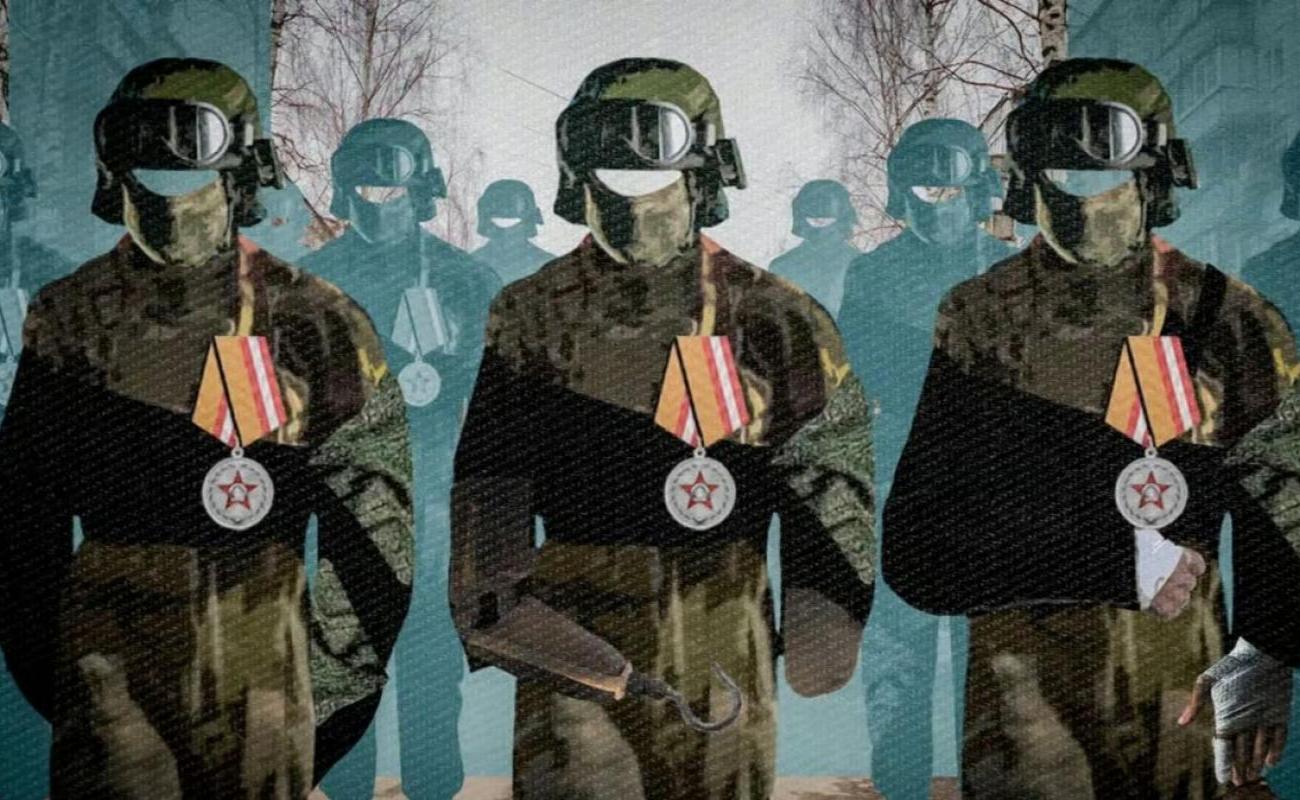
Invisible veterans

Since the start of Russia’s full-scale invasion of Ukraine, the Russian authorities have publicly downplayed the number of veterans who have re-entered civilian life after returning from combat. The latest figure cited by Russia’s presidential administration is 167,000. Yet even the most conservative independent estimates suggest that the true number is likely at least 400,000. To make sense of these figures, Novaya Gazeta Europe reviewed what’s known about returning veterans and came up with our own estimate.

In December 2025, Sergey Novikov, head of Russia’s Presidential Directorate for Social Projects, said that 167,000 servicemen had returned to civilian life. According to Kommersant, this figure likely only includes those who have received official combat veteran status. Novikov also mentioned a second figure: 250,000 more people who had come home but never appeared in the statistics of the state-funded Defenders of the Fatherland Foundation, created to support those who fought in Ukraine. He called this a “grey zone,” including tens of thousands of people who had neither sought help from the Foundation, nor found work. This estimate vanished from media coverage soon after, reportedly following “a call from the top.”

If these two groups don't overlap, that puts the real total at around 417,000. But how much should these numbers be trusted?

Counting recruits

Official figures cite 185,000 involved in the initial invasion, 300,000 mobilised soldiers, 1.9 million contract soldiers, and 164,000 volunteers recruited between 2023 and 2026. If these numbers are taken at face value, this would add up to at least 2.5 million people. Dmitry Medvedev, deputy chairman of Russia’s Security Council, has also given a more recent figure, claiming that Russia had recruited 422,700 servicemen in 2025 alone.

But experts and journalists remain sceptical of official claims. Based on military recruitment spending, independent outlet iStories and economist Janis Kluge calculated that at least 1.2 million people signed contracts with the Russian military between the fourth quarter of 2022 and the first quarter of 2026. Their most cautious assessment puts the number of contract and mobilised soldiers who fought in Ukraine between February 2022 and May 2026 at 1.5 to 1.6 million, not counting volunteers. This falls short of the 2.5 million listed above. So where did the rest go?

Two estimates can be made with more confidence: the number of soldiers who have been killed and the number who remain on the front lines. Meduza and Mediazona calculated that 352,000 Russian soldiers had been killed or reported missing in action as of late 2025, not counting anyone who was reported MIA after July 2025. Meanwhile, both Ukrainian officials and Putin have said that Russia maintains up to 700,000 troops in Ukraine.

Subtract soldiers killed and those still on the front lines from the 1.5 to 1.6 million estimate, and at least 400,000 should have already returned home. This roughly aligns with what independent experts told Novaya Gazeta Europe. Russian defence policy expert Pavel Luzin estimates “around 400,000,” while an analyst from the Conflict Intelligence Team (CIT) says that “500,000-800,000 people is entirely plausible.” But the question isn’t just how many have returned – it’s also who.

Ageing out of military service

From February 2022 until Vladimir Putin announced Russia’s mobilisation campaign in September 2022, soldiers could still leave the armed forces. Approval was difficult to get, but not impossible. Novaya Gazeta Europe wasn’t able to find estimates for exactly how many soldiers left the military during this period or if any were recruited for a second time during mobilisation. Officially, Russian authorities said they prioritised people with combat experience. In practice, however, they recruited almost anyone.

Military age limits offered another way out. Junior officers and enlisted personnel could retire at 50, and senior officers at 55. But in June 2023, Russia raised the maximum service age to 65. Although the law technically applied only to new contracts, the reality was different: the military simply stopped discharging anyone based on age.

The severely wounded

The seriously injured make up one of the largest groups of soldiers to return from the front. The International Institute for Strategic Studies (IISS) estimates that approximately 476,000 soldiers were severely wounded or disabled by early 2026. The Center for Strategic and International Studies (CSIS) puts the number of injured at approximately 900,000.

Part of the explanation lies in how the fighting itself has changed. By 2023, the war in Ukraine had turned into a drone war, with the area extending up to 20 kilometres from the front line becoming a “kill zone,” where enemy drones constantly spot and strike opposing forces. Evacuating the wounded from that zone has become extremely difficult, significantly increasing battlefield mortality. In 2022, for every soldier killed, approximately 1.7–2 were wounded. Today, that ratio is around 1 to 0.5, meaning twice as many soldiers are killed than they are injured. Meduza military analyst Dmitry Kuznets says a badly wounded soldier’s odds of survival now resemble those from World War Two.

But even serious injuries aren’t always enough for a soldier to be discharged. The military simply doesn’t convene the medical commissions meant to assess fitness for service. What’s more, injuries go unrecorded and wounded soldiers are routinely sent from the hospital straight back to the front. Still, based on the most conservative estimate, at least 300,000 soldiers should have received medical discharge by the end of 2025.

Mercenaries and volunteers

Wagner Group mercenaries are a particularly well-documented group. Mediazona and BBC Russian have obtained lists of payments made to relatives of killed soldiers, revealing the total number of Wagner’s prison and non-prison recruits. Based on their findings, Russia recruited at least 48,366 people from penal colonies. 17,251 of these mercenaries were killed by July 2023, when Wagner Group was liquidated following Yevgeny Prigozhin’s mutiny and march on Moscow. During a similar period, between July 2022 and July 2023, another 2,400–2,500 non-prison recruits were killed. Overall, around 78,000 people passed through Wagner.

This leaves around 31,000 former prisoners and 27,000 non-prison recruits who returned to civilian life after serving with Wagner. That’s likely the higher end, however, as some mercenaries signed on with Russia’s Defence Ministry after Prigozhin’s mutiny and went straight back to the front. In fact, Putin says several thousand fighters did so. Other former mercenaries may have ended up back in prison, and from there, also sent back to war.

While Wagner Group had the highest number of volunteer units, another 25,000 people signed volunteer contracts with the Chechen Akhmat unit (though an individual could sign more than once). Another 7,000 fought with the Redut mercenary group. In 2022-2023, the overall number of volunteers who fought on the front lines was estimated at 40,000. Today, volunteers can still sign short-term contracts lasting several months with BARS, Russia’s Combat Army Reserve. Since BARS units aren’t always necessarily deployed to the front, some officials join them to help boost their careers.

What we can piece together

Add up these categories and it’s possible to get a rough sense of who’s already returned: around 300,000 severely wounded or disabled soldiers, roughly 30,000 pardoned prisoners recruited before August 2023, 50,000 or more volunteers from Wagner, Akhmat, and BARS, and an unknown number who either left before mobilisation or aged out of service before the rules changed. It's a patchwork built from the few places where independent data happens to exist.

How many more soldiers are yet to return? In recent years, the rate of recruitment has either matched or surpassed Russia’s battlefield losses. This has allowed the Russian army to maintain a stable force of 700,000 troops in Ukraine. Unless the nature of the fighting changes dramatically, this means another 700,000 people could still come home once the war ends. Wounded soldiers will also continue returning from the front. Based on the most conservative estimates, around 5,000 injured soldiers return from the front each month. This adds up to 60,000 people per year. But the real number could be far higher, with the IISS estimating that approximately 100,000 Russian soldiers were injured in 2025 alone.

The Russian authorities don’t publicly release data about soldiers who were injured, killed, or returned from the war. What happens to them next is just as opaque. It's unclear whether any reintegration support is actually reaching veterans, or whether domestic violence and veterans' own risk of being crime victims have risen. The clearest signal so far comes from court data. Novaya Gazeta Europe has identified around 8,000 criminal convictions involving veterans of the war in Ukraine. Former soldiers appear among those convicted of murder and serious assault at rates far higher than the wider male population. That raises real questions about the challenges Russia will face as veterans continue to come home.