
RCF: 12 projects throughout BiH received almost 5 million euros for the improvement of professional education and training
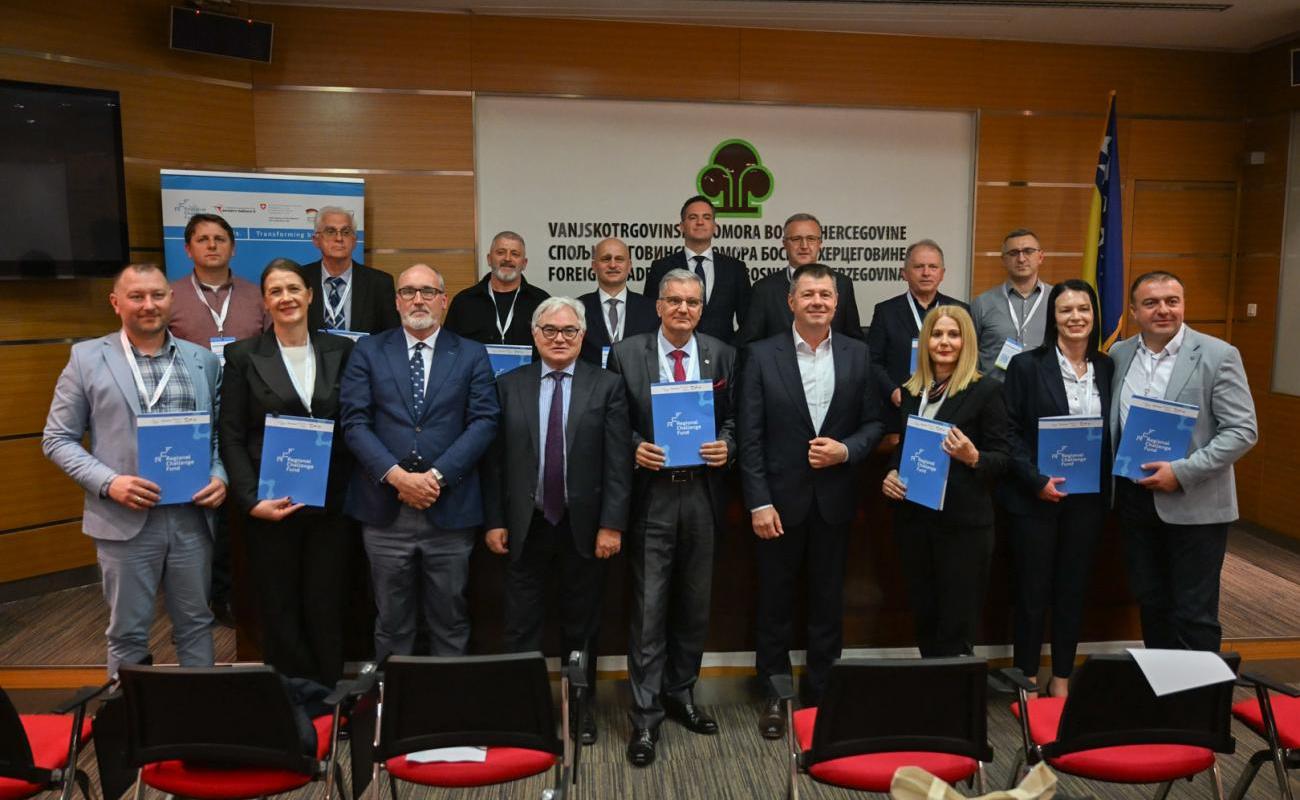
At a ceremony in Sarajevo today, grants were awarded to 12 of the most successful projects from Bosnia and Herzegovina, under the fourth call of the Regional Challenge Fund (RCF), totaling around 4.9 million euros.
With the largest total amount of funds awarded and the largest number of supported projects in the Western Balkans region, Bosnia and Herzegovina has stood out for its exceptional success. The supported projects connect vocational education and training (VET) institutions and companies with the aim of improving the skills of the workforce and strengthening the competitiveness of the domestic economy.
Addressing the audience, the President of the Foreign Trade Chamber of BiH, Ahmet Egrlić, emphasized that this very connection between education and the economy is the key to long-term development.
“The readiness of our companies to improve cooperative education programs and the quality of student training is best expressed in this fourth call. This is a great progress and thanks to these funds, educational institutions will provide new equipment and machines necessary for the practical training of students,” said Egrlić.
At a time when employers are increasingly facing the challenges of finding a skilled workforce, and young people are looking for opportunities that will motivate them to stay in the country, this type of support is changing the way we learn and work. Grants have been awarded to consortia that bring together schools, universities and companies to jointly develop programs aligned with the real needs of the labor market. These projects introduce a model in which students acquire knowledge directly through cooperation with the economy, both in the classroom and in the workplace.
The Ambassador of the Federal Republic of Germany to Bosnia and Herzegovina, H.E. Alfred Grannas, emphasized the importance of investing in people and knowledge as the foundation of any stable economy, while the Ambassador of Switzerland to Bosnia and Herzegovina, H.E. Gabriele Derighetti, further emphasized the importance of working together to provide young people with quality education and employment opportunities.
“The modernization of vocational education also represents a direct contribution to reforms on the path to the European Union. Investing in knowledge and people is crucial for a prosperous and European future for Bosnia and Herzegovina. I am pleased that we are successfully implementing the Regional Challenge Fund, both in BiH and throughout the Western Balkans. This is another example of a strong and long-standing partnership, and we believe that our cooperation will continue to contribute to the progress of Bosnia and Herzegovina on its European path,” said Ambassador Grannas.
Ambassador Derighetti added that it is good news that the private sector in BiH is increasingly willing to participate in such activities, and that the quality of applications has improved along with the quantity.
An important segment of the event was a panel discussion with representatives of the relevant ministries of education from different parts of Bosnia and Herzegovina, which discussed the challenges and opportunities for improving vocational education, as well as the role of international projects in the reform of the education system.
The Regional Challenge Fund Project Coordinator at the Western Balkans Chamber Investment Forum 6, Balša Ćulafić, emphasized that such cooperation models are already yielding concrete results across the region: “This is another important step in strengthening the skills needed in the market. The fourth call has achieved very good results – so far we have supported 24 projects, with almost 10 million euros. This is a clear signal that we are investing where there is the greatest strength, which is the development of industry, new competencies and smart production. These skills are key to the competitiveness of companies.”
Out of a total of 187 applications from the Western Balkans region, 32 came from Bosnia and Herzegovina, of which 12 were selected for funding. The projects come from all over the country – from Banja Luka and Bijeljina, through Sarajevo and Travnik, to Mostar, Ljubuški and Tuzla – and involve more than 70 companies.
You can find out more about the awarded projects at: www.youtube.com/watch?si=tfh2UOrRTPAkDmpO&v=CPqP-CdRL-A&feature=youtu.be
Supported programs focus on professions and skills that are in high demand today: from CNC operators and welders, through electrical engineering and mechatronics, to the digitalization of production and green technologies. What sets them apart is their strong practical orientation – students will not only learn from textbooks, but also through practical work on modern equipment and direct cooperation with companies.
The Regional Challenge Fund was launched six years ago with the aim of helping the economies of the Western Balkans to get closer to the European market through investments in knowledge and skills. Within the four cycles so far, a total of 24 projects in Bosnia and Herzegovina have been supported, with investments of almost 10 million euros and partnerships involving around 150 companies.
The German Federal Ministry for Economic Cooperation and Development (BMZ) has provided 73.4 million euros for the Regional Challenge Fund, while the Government of Switzerland, through the Swiss Agency for Development and Cooperation (SDC), has co-financed an additional 10 million euros. The funds are entrusted to the KfW Development Bank, and the project is implemented by the Western Balkans Chamber of Investment Forum 6 (WB6-CIF).
For more information, follow the Regional Challenge Fund via its official social media channels and website https://rcf-wb6.org/