
Сost of dependence: Russia's economic downturn hits Belarusian consumers
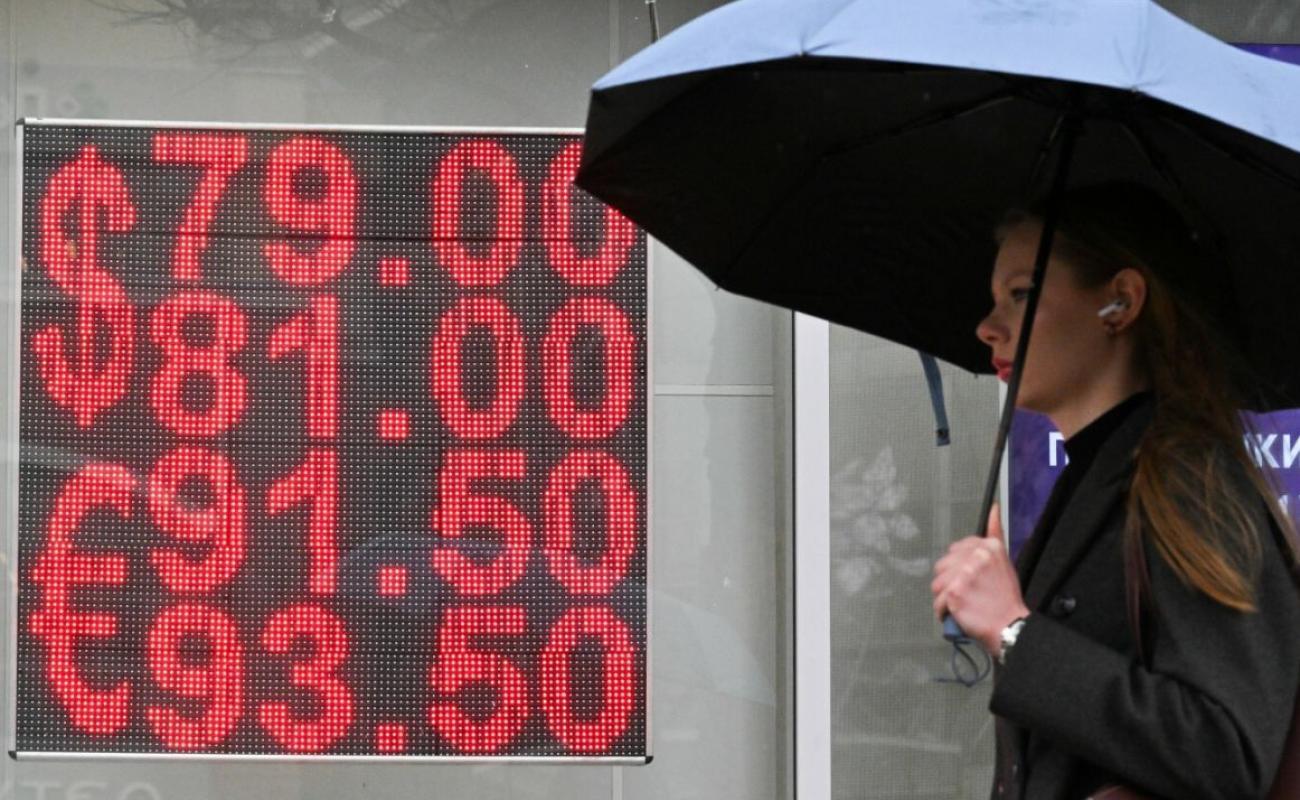
The Russian economy contracted in the first quarter, and officials are predicting further declines. Even Vladimir Putin has acknowledged the issues at hand. Since the Belarusian economy is closely tied to Russia's, these problems are also affecting Belarus. Experts believe that it is very likely that people in Belarus will see store prices rise above those in Poland. Belsat has sought to understand what is happening in the Russian economy and the implications for the people of Belarus.
The decline in Belarus and Russia is approximately the same
From the perspective of the dynamics of the Belarusian and Russian economies, the situation is similar, notes Aliaksandr Knyrovich, a businessman and host of the "Atmosfera" program on Belsat. In Belarus, the authorities planned for 2.8% growth by the end of 2026. Russia's Ministry of Economic Development expected its economy to grow by 1.3%.
"The first quarter showed that it's not just that there is no growth, but that there is a decline, and in a large number of sectors," says Aliaksandr Knyrovich. In the first quarter, the Belarusian economy contracted by 0.4%, and the Russian economy by 0.3%.
,,"Wherever there are problems in Russia, there will always be problems in Belarus. Russia has already been spending huge amounts of money on the war for four years – approximately 160-190 billion USD annually. – Ed. belsat.eu]. At first, it was spending its reserves. By 2025, that money ran out, and a hole appeared in the budget. This year, it became very apparent. Approximately 50 billion USD, at current exchange rates, which was planned as the budget deficit for the entire year, was spent in 70 days," says Knyrovich.
It was compounded by the actions of the Russian authorities, who were fighting high inflation. To curb price growth, the Central Bank of Russia raised its refinancing rate. A shortage of available funds for companies and businesses slowed industrial development.
,,To top it off, they raised taxes to replenish the budget. VAT increased by 2 percentage points to 22%. The more you raise taxes, the less room the economy has to grow. And so, Putin enters the second quarter of 2026 with military spending that is excessively bloated relative to the Russian economy, draining the lifeblood from other sectors," continues Aliaksandr Knyrovich.
In his opinion, even an immediate end to the war will not lead to a sharp growth in the Russian economy, and the problems are long-term.
Russia still has resources
Economist Yaraslau Ramanchuk also points to the decline of the Russian economy, but suggests looking at the absolute figures as well:
,,"When even such a large and resource-rich country has been waging such a large war for four years, the growth rate is bound to slow down. However, Russia's GDP in 2025 amounted to about 2.6 trillion USD. That's 750 USD billion more than in 2021. The same goods exports reached 418 billion USD, although there was a slowdown [a decrease of 6.2 billion USD compared to 2024. – Ed.]."
It indicates that, despite the sanctions and slowing growth, Russia had enough resources for the war, the economist notes.
As for the budget deficit in Russia, it's not worth drawing conclusions based on the first quarter, he emphasizes:
"What's more, we see that in 2025, their budget deficit was 2.6% of GDP. In America, it was 7.5%. In the European Union, it's 3.5%, or even 5% in some countries."
Ramanchuk adds that, for a country focused on development and economic growth, Russia's results are a scandal. However, for Russia itself, this is not a big problem:
"Putin himself has admitted that the growth rate has slowed. So, the pressure on businesses will have to increase. Taxes have gone up. There is no cheap credit. But look at average wages, over a thousand dollars, that's also a record high. So, unfortunately, the Russian economy has gained momentum. Undoubtedly, this economy will face a severe crisis after Ukraine's victory. But for now, there are still resources."
"If there are no black swans, then for another three to four years Russia will definitely be able to spend money on the war at the same pace," the economist suggests. Consequently, some of that money will also reach Belarus, whose enterprises are profiting from the war.
"Lukashenka has latched onto Russia," says Ramanchuk.
According to him, Belarus will continue to benefit from Russia, but to a lesser extent due to Russia's declining fortunes.
Belarus will be stuck in a "quagmire"
Aliaksandr Knyrovich says that Belarus is already facing a crisis because of the model chosen by the Belarusian authorities: one that orients itself toward Russia and its problems. However, this is not the kind of crisis you might imagine, like the early '90s, the 2009 crisis, or the one in 2011 when the dollar tripled in price.
,,"Our crisis looks like we are stuck in a quagmire. A 15% growth was planned for the five years. That's out of the question," Knyrovich emphasizes.
He expects that in the coming years, Belarus will experience stagflation, a situation where the economy is contracting while prices are rising sharply.
"In individual months, we might see a sharp jump in wages, like in March, but in the long run, we should see inflation outpace wage growth. It isn't something a Belarusian will feel on a day-to-day basis. Just by coming to Poland and Lithuania, he will notice an ever-widening gap between his standard of living and that of other countries," adds Aliaksandr Knyrovich.
"Prices in Belarusian stores may become higher than in Polish ones," the source suggests.
"They are already very close – last year the Polish food basket was only 8% more expensive, whereas previously that figure was 30%," says Knyrovich.
Yaraslau Ramanchuk expects an even worse scenario, which will be tied to the end of Russia's war against Ukraine.
,,"Lukashenka is a beneficiary of the war, and that works in the short term when there is a market, but, like in the Soviet Union, the economy works only for one market and one specific situation. Once this all ends, a true test will emerge, comparable only to the collapse of the Soviet empire," adds Ramanchuk.
The economist believes that if Russia is "feeding" the Belarusian economy now, after the war, it will look to take what it can from Belarus. First and foremost, this is human capital, as well as the opportunity to squeeze Belarusian businesses out of the Belarusian market.
"When have the Russians ever lived well? That's how it will be for us. The quality will be Russian, the business practices will be Russian. No one will think about technological development. Today, there is a huge shortage of highly qualified workers in the Russian market. And it will suck people out of our country like a vacuum cleaner. It will be a very dangerous integration. Those who are dissatisfied will leave," Yaraslau Ramanchuk concludes.